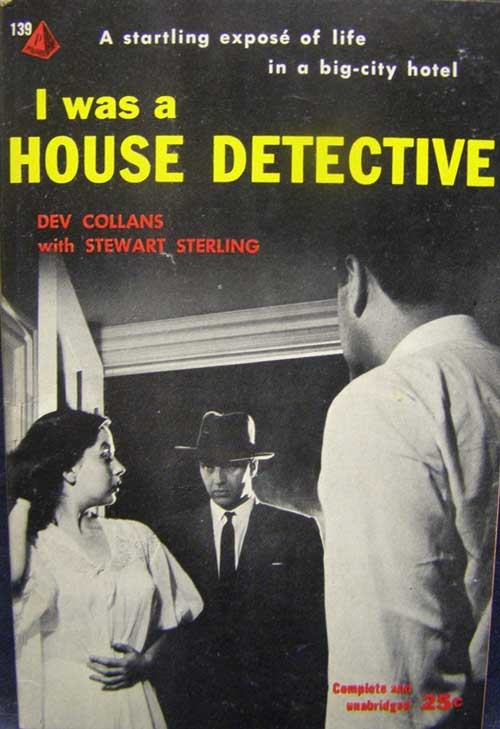
 Who actually wrote this book? The lead author, Dev Collans, was a name made up to protect the identity of the house dick who was active at the time the book was written. “Collans” provided all the content to the writer, Stewart Sterling, who actually wrote it. In fact, Stuart Sterling is also a pseudonym—for Prentice Winchell (1895–1976), a prolific pulpster who was one of the original “Black Mask Boys,” and wrote dozens and dozens of short crime stories. He wrote several series characters including nine novels with Don Cadee, a department store dick.
I suspected the promise of a house detective would be more exciting than the reality, and that turned out to be the case. In fiction, the house dick is typically one step ahead of law enforcement and perennially involved in the most dangerous and titillating crimes like murder, extortion, or human trafficking. A real house officer deals with crimes like robbery, vandalism, unauthorized pets, prostitution, disturbance, and more rarely suicide. Collans worked at several hotels in the New York City area. At least one was 8-stories, housing something on the order of 1000 rooms. These were major operations and employed an astonishing number of staff to keep the places running. Many of the onsite accoutrements like salons, bars, groceries, newsstands, etc. were actually contract services not directly staffed by hotel personnel.
“it would be well within the range of possibility for a baby to be born in an up-to-date, big-city hotel, and—assuming the building wasn’t torn down to make way for a bigger one—grow up, get married (and maybe become a parent) without ever leaving the premises. Just about anything a person might need can be found in, or easily brought to, a metropolitan hotel. Everything, that is, except a cemetery.”
The house dick had relatively little authority. He had to play things smart and rely more on insistence and polite assertion than direct intervention. He often gained entry into a suspect’s room on a claimed electrical or plumbing problem that required immediate attention. His milieu was low-tech, circa 1957. All the rooms were keyed with physical keys. His trump card was a master key which could not only open any door in the building, but it could also lock them so that the room key would no longer work. This was useful for leverage for freeloaders who refused to pay their bills. If they wanted their possessions, they’d need to settle up before they’d be let back into their room to collect their belongings.
The book is well-written, edifying, and moves along fast enough to hold your interest. I’d rank it 3 out of 5 simply because it just couldn’t live up to the magic the words “house detective” evoke in fiction. As an engaging, fact-filled report on the state of the art in the late 1950s, it probably deserves a five.