Category

Reviews

Category

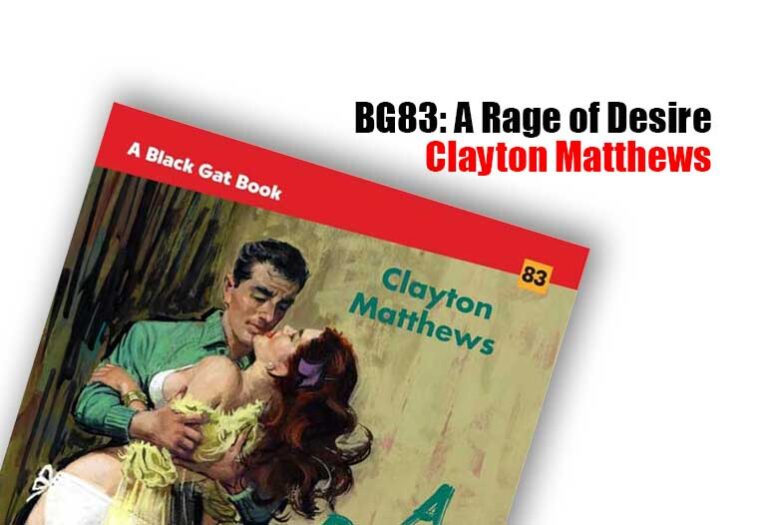
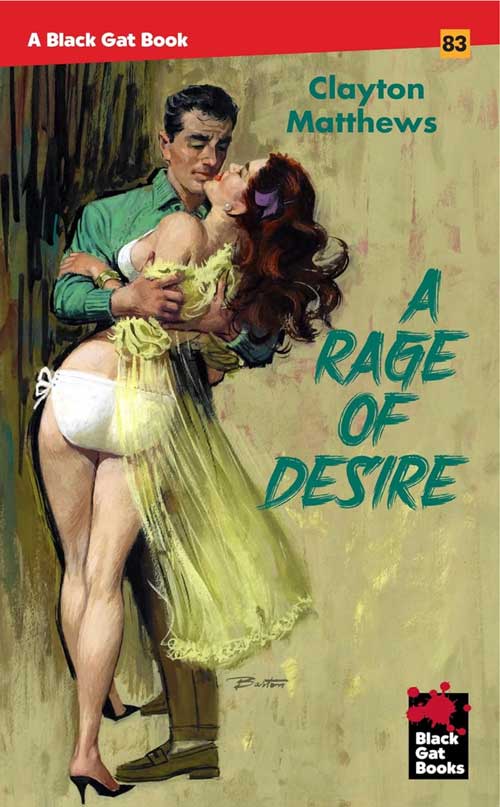
BG83: A Rage of Desire by Clayton MatthewsMitch Sutton has—if not everything—most of the American dream a 1960-era everyman would want: beautiful wife, two lovely children, a solid job, and a home of his own. But lately, there’s no spark between him and Claire, so he ain’t happy. She doesn’t think much of his drinking, so he’s tried to curtail the habit. But one fateful night he overindulges and hooks up with Jane, a self-assured, brazen, sugar plum. They crawl the pubs into the wee hours, and she leaves him flat-footed and smoldering. That should’ve been that, a high wire dance that ended safely, but Mitch is smitten and can’t get her off his mind.

Now, it’s an obsession, and his compulsion twists into something far more complicated when Jane turns up at the dealership where he works as sales manager. Soon the flames of desire overcome the heat of the danger of discovery, and Mitch is headlong into a full-blown illicit affair. Many steamy paragraphs and pages ensue.

Just when you start to wonder if this is a torrid romance novel or a crime book, Mitch finds himself behind bars in the fight of his life.

A Rage of Desire was Clayton Matthews’ (1918–2004) first novel, published in 1960. His commitment to writing is proven by an impressive bibliography of more than 35 novels. He also penned shorts for crime digests like Mike Shayne, Alfred Hitchcock, and Man from U.N.C.L.E. He married Patricia (Brisco) in 1972 and the couple wrote five novels featuring series character Casey Farrell.

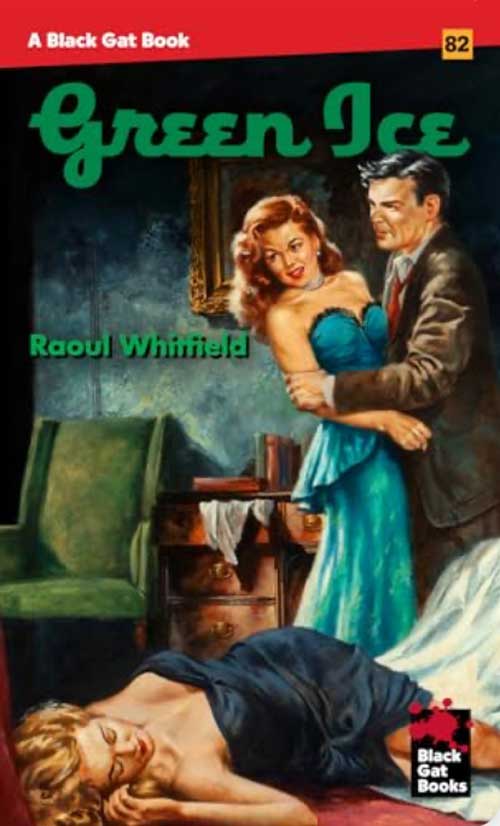
BG82: Green Ice by Raoul WhitfieldRaoul Whitfield (1896–1945) was a pal of Dashiell Hammett, who weighed in on Green Ice for the New York Evening Post. “The plot doesn’t matter. What matters is that here are 280 pages of naked action pounded into tough compactness by staccato, hammer-like writing.” It’s an impressive blurb, and now that I’ve read the novel it’s easier to unpack.

Perhaps Hammett dismissed the plot rather than try to explain it. It’s complicated. Green Ice, which was Whitfield’s first novel, is packed with a large cast even for a mystery novel. It was intentional because there’s a high body count and many of the yeggs and fatales only live to see their end rather than The End.

Mal Ourney is a newshound sucked into the charms of bad girl Dot Ellis. So much so, he takes a rap on her behalf and serves of two-year bit without remorse. Green Ice opens with a bang as the two are reunited upon Ourney’s release, and plunges him head-first into a confusing and complicated mystery littered with bullets, bodies, and booty. Dot is the first casualty of this rapid-fire fracas.

Ourney’s been out of circulation so it takes him a considerable chunk of pages to figure the potential angles and motives of a dynamic cast that enters and exits as he attempts to unravel the shreds of information he extracts or extorts. His opponents and allies shift throughout. And there’s more than one crook who knows more than our hero. Plus, there’s the cops. Somehow, Ourney prods or plops himself into the middle of every single thing and is repeatedly duped, dumped, or detained for interrogation.

The plot is important, but not so important that readers need keep every detail and actor in mind. The plot is the framework upon which Whitfield showcases his command of action, 1920’s slang, and descriptive magic. This is one rocket-powered street race, drenched in a shower of hardboiled prose.

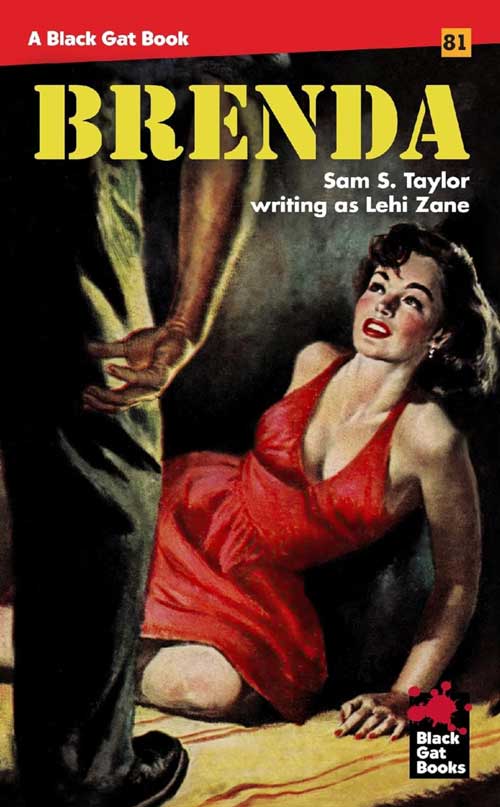
BG81: Brenda by Sam S. TaylorAll the elements of a classic rural noir are present here, including solid prose. Still, Brenda just didn’t do it for me. When characters behave so illogically it breaks the suspension of disbelief and leaves you disconnected from the action and its intended emotional response, it’s too much. That’s Brenda, Boyce, Conrad, Frances, and even several of the secondary characters.

Conrad returns home from Korea to the farm where his Uncle Boyce and now deceased Aunt Norma, raised him. Boyce is blindly infatuated with the decades-younger, hottie, Brenda, who is adamant to prove she can seduce and scorch any man she chooses—even if it requires wedlock. Boyce is exasperatingly old school, and somehow believes he can return to eking out an existence via dawn-to-dusk farm work with city babe Brenda transformed from playgirl into hard-working farmer’s wife overnight. Brenda breaks that mold in a New York minute, and even turns her seductive sonar onto Conrad. Oh, what a tangled mess she weaves!

Originally, written under the pen name Lehi Zane, Brenda, was first published by Gold Medal in 1952. Taylor also wrote three detective novels, all featuring PI Neal Cotton, for Dutton/Signet from 1950 to 1953.

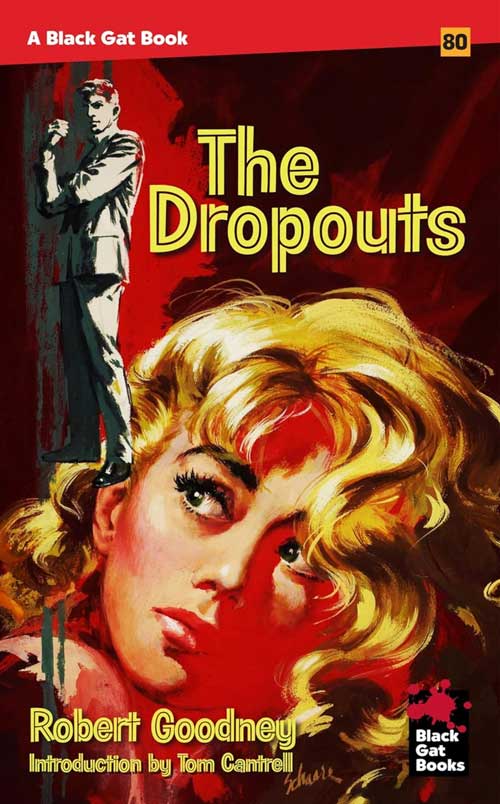
BG80: The Dropouts by Robert GoodneyThe lives of two battered down-and-outers cross paths mid the shadowed streets of NYC. Both protagonists are wrought from dubious roots; and despite good intentions, and some desire to “straighten” themselves out, both are unable to overcome their baggage. Shaker returns to the scene of the Houston Hotel where he previously lived, scraping by as a substitute desk clerk at odd hours. He longs for Mexico, where he imagines life will be golden. Meanwhile, Cass lives in a similar dive and works a dead end job far below her potential. The two connect, and subconsciously attempt to complete each other. But their primary commitment remains in their broken identities, and they seem unable to overcome their scars to embrace a better reality. Shaker in particular.

The Dropouts is a fine character study of the struggling class and the lost souls it produces. Goodney, whom we learn from Tom Cantrell’s informative introduction, died at the age of 29. This was his only novel and includes several unusual narrative techniques and copious descriptors of setting. Like the novel itself, readers are left hoping there was more his story to be told.

Detour at Night by Guy EndoreThree things attracted me to this Award Books  (A145F) paperback. One, it’s An Inner Sanctum Mystery, a series I’ve noticed from time to time due to enjoying the OTR series of the same name. Two, the author. I read his Werewolf of London several years ago and remembered his writing abilities. Three, the price of admission. I bought it for $3 at Robert’s Book Shop in Lincoln City the last time I was there.

This book, and perhaps the series, seems to have little to do with the OTR series. The books are (I believe) original novels, not adaptations of radio shows. Their genre aligns, but other than that, the large header seems to be intended only to leverage the old show for its marketing oomph. However, it does make the books a series and adds to their collectibility.

Detour at Night is unlike anything I’ve read before. It is nearly a novel of digressions, like Dan Brown on steroids. Here, the sidebars are pure unadulterated wordplay. Endore must have been fascinated with language and word origins and their derivations. His prose rambles, but it’s lively and remarkably holds your interest despite pages of inaction. In fact, it takes almost until the halfway point, before we begin to understand what this story is about and why it’s a mystery.

Perhaps that’s why the pull quotes on the cover confine themselves to single words: “Intense” and “Masterly.” The back cover expands with “Off the beaten track” and “Unexpected and dazzling.”

What is it about? Orphaned Frank Willis survives his childhood by burying himself in words and phrases that grow into the beginnings of a career in academia. But his trajectory is derailed when he’s accused of the murder a young woman whom he’d begun courting. The evidence against him is damning, his arrest contingent only on the discovery of her body.

I rate this one at 3-1/2 stars for its originality and entertainment value. As a mystery, I think that range is appropriate as well. Readers who particularly love words and language might want to add another star.

I was a House Detective by Stewart SterlingWho actually wrote this book? The lead author, Dev Collans, was a name made up to protect the identity of the house dick who was active at the time the book was written. “Collans” provided all the content to the writer, Stewart Sterling, who actually wrote it. In fact, Stuart Sterling is also a pseudonym—for Prentice Winchell (1895–1976), a prolific pulpster who was one of the original “Black Mask Boys,” and wrote dozens and dozens of short crime stories. He wrote several series characters including nine novels with Don Cadee, a department store dick.

I suspected the promise of a house detective would be more exciting than the reality, and that turned out to be the case. In fiction, the house dick is typically one step ahead of law enforcement and perennially involved in the most dangerous and titillating crimes like murder, extortion, or human trafficking. A real house officer deals with crimes like robbery, vandalism, unauthorized pets, prostitution, disturbance, and more rarely suicide. Collans worked at several hotels in the New York City area. At least one was 8-stories,  housing something on the order of 1000 rooms. These were major operations and employed an astonishing number of staff to keep the places running. Many of the onsite accoutrements like salons, bars, groceries, newsstands, etc. were actually contract services not directly staffed by hotel personnel.

“it would be well within the range of possibility for a baby to be born in an up-to-date, big-city hotel, and—assuming the building wasn’t torn down to make way for a bigger one—grow up, get married (and maybe become a parent) without ever leaving the premises. Just about anything a person might need can be found in, or easily brought to, a metropolitan hotel. Everything, that is, except a cemetery.”

The house dick had relatively little authority. He had to play things smart and rely more on insistence and polite assertion than direct intervention. He often gained entry into a suspect’s room on a claimed electrical or plumbing problem that required immediate attention. His milieu was low-tech, circa 1957. All the rooms were keyed with physical keys. His trump card was a master key which could not only open any door in the building, but it could also lock them so that the room key would no longer work. This was useful for leverage for freeloaders who refused to pay their bills. If they wanted their possessions, they’d need to settle up before they’d be let back into their room to collect their belongings.

The book is well-written, edifying, and moves along fast enough to hold your interest. I’d rank it 3 out of 5 simply because it just couldn’t live up to the magic the words “house detective” evoke in fiction. As an engaging, fact-filled report on the state of the art in the late 1950s, it probably deserves a five.

Fate Magazine No.741A wide range of reports on the strange and unknown are included in the current issue of Fate Magazine. This is typical, and this issue delivers as promised. My favorites were the cover story on skinwalkers and the article on their cousins, the bearwalkers, of the Ojibwe. I also enjoyed Rick Botelho’s “UFOs—A Realistic Assessment” perhaps the longest article ever to appear in the magazine; and George Schwimmer, Ph.D.’s “Earthbound Spirits are Attached to You.” These pieces had the most appeal for me, but there are plenty of other topics explored.

Unless you dwell in a large metropolis you may have trouble locating a copy. Best to subscribe. If you don’t like your magazines arriving with a mailing label attached, Fate offers premium subscriptions so your issues arrive in an envelope.

BG79: Walk the Dark Streets by William KrasnerJoe Marco looks more like a jockey than a gangster. He role-plays a law-abiding club owner, but Detective Captain Sam Birge can see beneath the veneer. Marco is careful to cover his tracks, but Birge recognizes the hood’s hidden ventures encourage exactly the sort of crimes that the detective faces every day. This time, it’s the murder of one of the Club Trinidad’s hostesses—stage named Janice Morel. Knifed in her twin-size at the fleabag Marne while comatose from a night inscribed with cheap liquor.

Birge and his partner, Charley Hagen are opposites. Birge is older, wiser, and measured. Hagen is young, ambitious, and overly aggressive. Birge is a likable character, while Hagen is more the stereotypical tough cop who beats out a confession to speed up a conviction. That’s where Harry Chapel comes in, a low-life with baggage; and intimate of Ms. Morel. Initially, Chapel is merely a person of interest, but Hagen’s threatening accusations transform him into suspect number one when he flees the scene immediately following his browbeating.

Noir excellence, rife in character depth and engaging prose, this Edgar-nominated first novel by Krasner (1917–2003), was originally published in 1949. Detective Birge would go on to appear in four additional novels, although one saw print only in Germany.

Fact, Fictions, and the Forbidden Predictions of the Amazing Criswell by Edwin Lee CanfieldFact, Fictions, and the Forbidden Predictions of the Amazing Criswell by Edwin Lee Canfield

The life and times of showman prognosticator Jeron Criswell revealed through friends, appearances, and ample predictions. His public demanded a metric on the accuracy of his torrent of forecasts, so he responded with 87%, a predictable fabrication emphatically stated as fact. No matter, he knew accuracy was not the point. His decades of prophecies were entertainment—enthusiastic, creative, often shocking, and remarkably, nearly endless. (Only occasionally true.)

Author Canfield has given us the closest look we’re likely to get into the life of an American original. Exhaustively researched, with fascinating side trips into the lives of his estranged wife, Halo Meadows,  friends, and associates, Criswell presents an in-depth examination of the prognosticator’s lifelong pursuit of the limelight. His rise from publishing limited edition pamphlets to his move to Los Angeles, from his eventually widely distributed “Criswell Predicts” newspaper column to his numerous appearances on the talkshow circuit (Jack Parr, Johnny Carson, Merv Griffin, etc.), to his slow decline as his cashflow trickled downward. It includes details on his association with Ed Wood and his entourage, both behind the scenes and in front of the camera.

A must-read for fans of cult heroics with noirish tendencies.

BG78: One Foot in Hell by Wilene ShawThe fact that Larry Crenshaw is a successful accountant, model husband, and a solid citizen of his native burg, fictitious Hadsville, Kentucky, located on the banks of the Ohio River, belies his reliability as a narrator. He juggles a few quirks, but generally hides his massive psychological dysfunction pretty well. He successfully deludes himself as he denudes nearly every female he encounters—her age notwithstanding. Readers witness the slow boil of his undoing as his alternate reality rises into a deadly hallucination of sanity.

Crenshaw is obsessed with sex, and it becomes obvious as pages accumulate that it’s the driving force of his existence; even if he can’t seem to recognize this fatalistic fact himself. His psychosis grew out of a brutal childhood past, fed by early promiscuity-interruptus and a tragic marriage, Crenshaw spirals into a sex-starved, booze-infused frenzy that leads to one crippling consequence after another.

Originally published by Ace in 1961 under Virginia M. Harrison’s pseudonym, Wilene Shaw. Although it was written long after the jazz age, its kilter would seem to fit comfortably within Stark House’s Staccato Crime series. Stark House previously published Shaw’s Heat Lightning in their first collection of Ace paperbacks: Three Aces (May 2023)