Award-winning poet Frederick J. Mayer’s short story, “Zhar’s Outré House,” is a meld of poetry and narrative that delights in description over deed. For example: “The vivacious vixenish lead vocalist gave a fleeting foxy wink to her awaiting, appreciating, but inattentive friends situated in the darkly lit place’s menses red vinyl half-moon shaped booth. Dr. Anne du Voor, whose robust rotundity displayed how an obese form could show no excess fat; Dr. Koh Rei-mi’s, in her prime forties, physique could of been that of a young model for August Rodin and Lady Jones.”
Contents
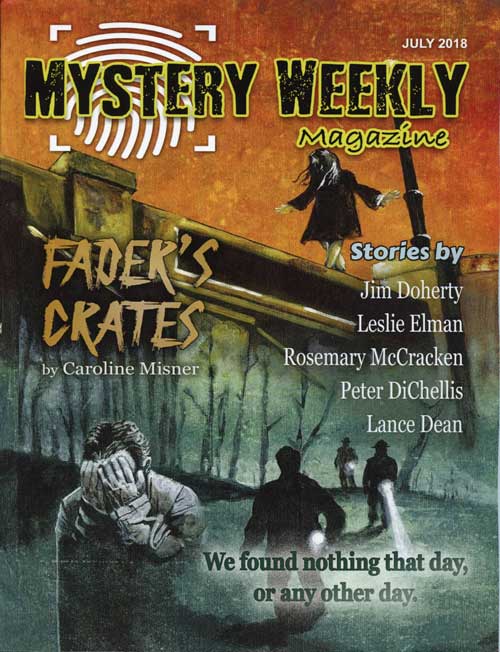
Jim Doherty “Cap Device” Rosemary McCracken “Black Bear Country” Caroline Misner “Fader’s Crates” Leslie Elman “No Quarters” Lance Dean “Rock on the Rocks” Peter DiChellis “Locked Tight” Laird Long “The Sound of Silence” (A You-Solve-It)
Solution to May You-Solve-It “In the Crosshairs” by Laird Long
Mystery Weekly Magazine July 2018
Publisher: Chuck Carter
Editor: Kerry Carter
Cover: Andreas Larsson
7.5” x 10” 77 pages POD $5.99, Kindle $2.99 Mystery Weekly Magazine website
From International Science Fiction No. 1 (Nov. 1967):
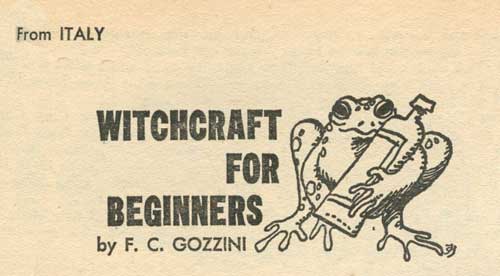
From Italy, F.C. Gozzini contributes the very short “Witchcraft for Beginners.” It’s about a wonderful new weekly periodical, Witchcraft for Beginners and the two brothers who practice the spell detailed in each edition. Unfortunately, when the next issue suddenly fails to appear, they are both left in a lurch with no one to spell them.
Contents
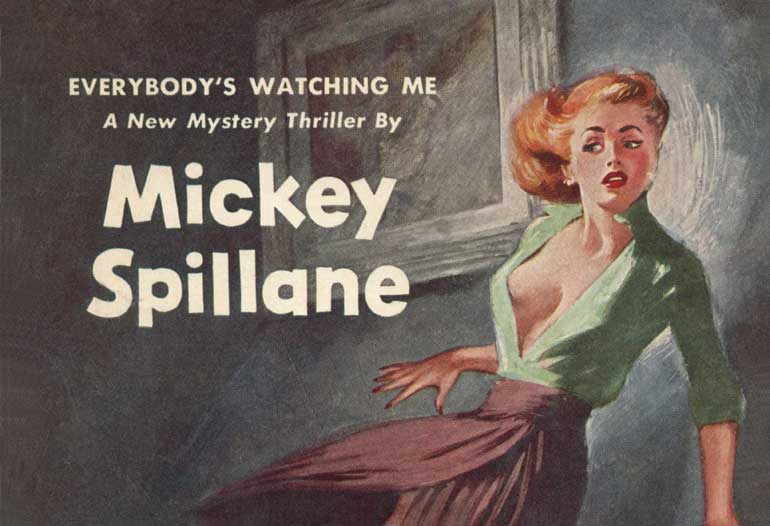
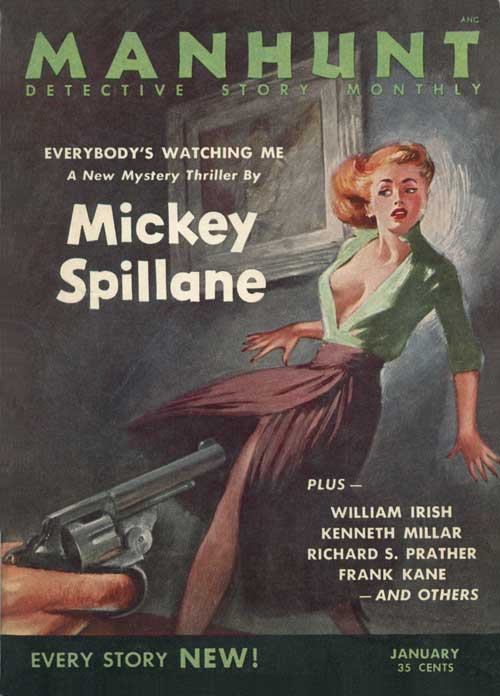
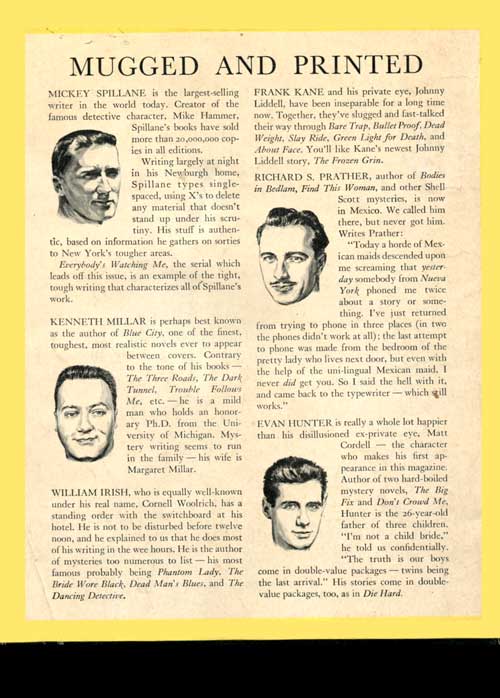
“Everybody’s Watching Me” by Mickey Spillane (Part 1 of 4) art by Joe Kubert
“Die Hard” by Evan Hunter
“I’ll Make the Arrest” by Charles Beckman, Jr.
“The Hunted” by William Irish
“The Best Motive” by Richard S. Prather (Shell Scott)
“Shock Treatment” by Kenneth Millar
“The Frozen Grin” by Frank Kane (Johnny Liddell)
Backfire by Floyd Mahannah
“The Set-Up” by Sam Cobb
“Who is Vetter?” (coming next issue)
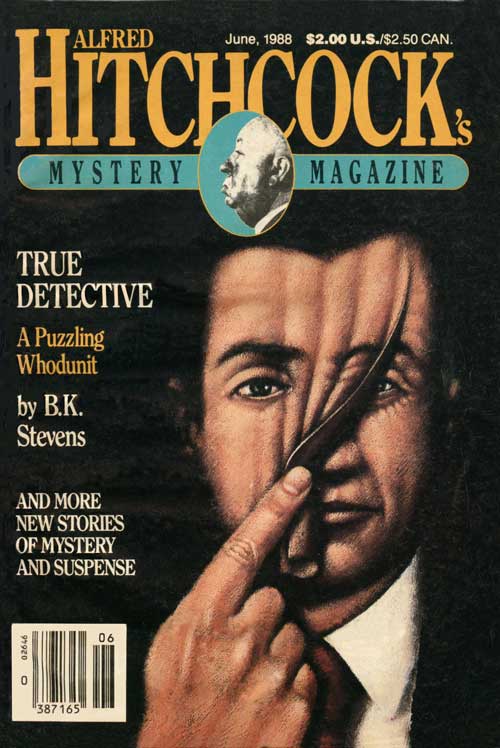
TDE: How did the Lt. Johnson and Sgt. Bolt series develop, and why did you choose to tell the stories as letters?
BKS: Believe it or not, the premise for the Walt Johnson and Gordon Bolt series came to me in a dream. I’d been writing mysteries for two or three years, without coming up with anything publishable, when I woke up one morning with a vivid impression of a scene. Two police detectives are walking across the grounds of a large estate, talking. The first detective says, “It was a clever murder, wasn’t it?” The second replies, “Not so very clever—unless you mean the part about the horse.” The first detective is utterly confused—it had never occurred to him that a horse might be involved. “What horse?” he demands. The second detective misinterprets his question and says, “Does it matter what horse? One from the stables, I suppose.”
That sliver of conversation defined the characters of Walt and Bolt, established the relationship between them, and set the pattern for every story in the series. Walt Johnson is a highly respected police lieutenant. Everyone, especially his adoring subordinate, Sergeant Gordon Bolt, sees him as a brilliant detective. But Walt is in fact a dim bulb, earnest and well-meaning but always in a fog. He blunders through his cases, missing every clue, blurting out clichés and irrelevant observations that reveal just how lost he is. Bolt, much smarter than Walt but far too humble, thinks Walt is a genius and seizes on everything he says, misinterpreting all his muddle-headed remarks as dazzling deductions. Bolt’s the true detective. He’s always the one who figures everything out, and Walt’s always the one who gets the credit. Walt feels guilty about it but lacks the courage to admit the truth to anyone, including Bolt. That’s the basic plot for all twelve Bolt and Walt stories.
As for the letter-writing form of the stories, I read several epistolary novels in graduate school, including Samuel Richardson’sPamela and Clarissa—I didn’t love the novels, but I was intrigued by the form. (And I relished Henry Fielding’s epistolary parody of Richardson, Shamela.) I also read Wilkie Collins’The Moonstone, an early mystery and a variation on epistolary form, and I was struck by Jane Austen’s use of long letters in novels such as Pride and Prejudice. When I gobbled up Dorothy Sayers’ works, I liked her use of epistolary form in “The Documents in the Case,” a long short story she wrote with Robert Eustace. So when I cast about for a way to tell Walt’s story, epistolary form occurred to me as a possibility. Walt is plagued by guilt because he’s become a success by taking credit for Bolt’s accomplishments. He needs to confess, and to whom should he confess if not to his mother? In the third story in the series, “True Romance,” Walt’s widowed mother emerges from the letters when she pays Walt a long visit and wins the heart of Sergeant Bolt. That story is told in the form of a long letter from Walt to his ever-patient wife, Ellen. Of course, Walt has no idea that his mother and Bolt have fallen in love, just as he has no idea of what’s going on in the case he and Bolt are investigating; readers have all the evidence they need to realize the truest romance in “True Romance” is the blossoming one between Bolt and Mrs. Johnson, but Walt never suspects. All the other stories, as I recall, are written as letters from Walt to his mother—except that by the eleventh story, “True Test,” Walt has switched to e-mail, and breaks off suddenly when Ellen goes into labor with their second child. The final story, “True Enough,” is a letter Walt writes to his mother while she and Bolt are on their honeymoon.
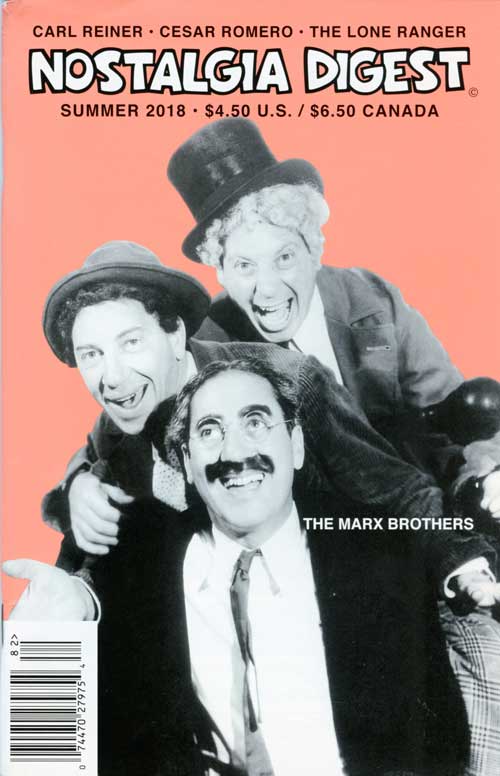
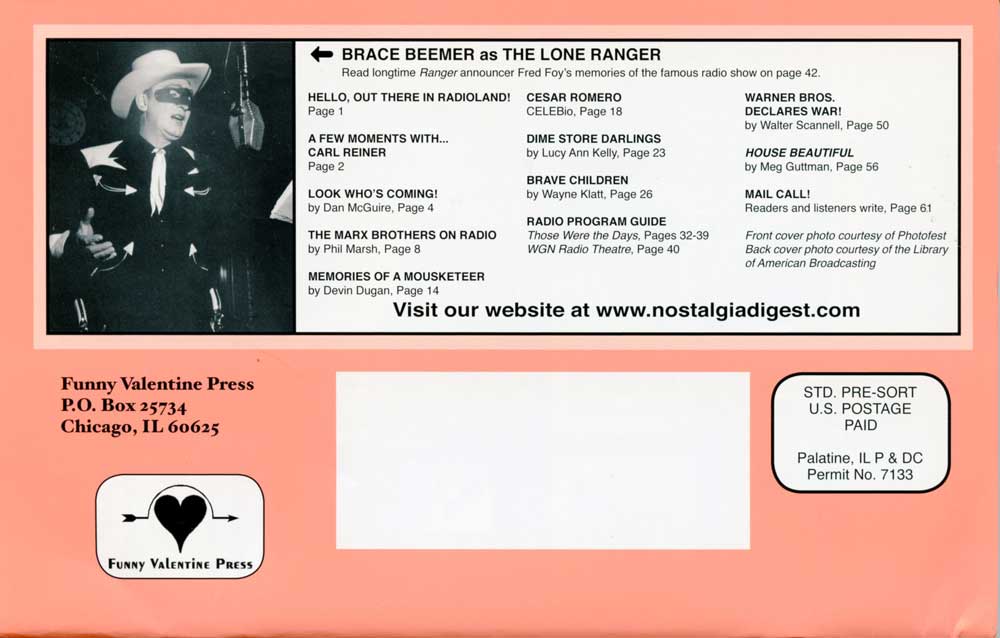
Contents Steve Darnall: Hello, Out There in Radioland!
“A Few Moments with . . . Carl Reiner” (uncredited) Dan McGuire “Look Who’s Coming!” Remembering those folks who were part of the neighborhood. Phil Marsh “Band of Brothers” (cover story) The show that brought the Marx Brothers (well, two of them, anyway) to radio. Steve Darnall “Radio Harpo” Devin Dugan “The Memories of a Mousketeer” Sherry Albertoni recalls Walt Disney, Lou Costello, and a lifetime of “instant connection and friendship.”
Celebio: Cesar Romero (First issued in 1949 by Harry Brand of 20th Century-Fox) Lucy Hall Kelly “Dime Store Darlings” Remembering Sweet Susie and Little Cindy, and the stores that sold them . . . and a whole lot more. Wayne Klatt “Brave Children” Fred Foy “Who was that Masked Man’s Announcer?” Excerpt from A Masked Man, An Indian and Me. Walter Scannell “Warner Bros. Declares War!” How a movie studio took the front line against the Nazis . . . with the help of Emile Zola, Sgt. York and a Sea Hawk. Meg Gurrman “Mid-Century Mavens” One writer’s visit to the 1950s . . . with a little help from House Beautiful.
Mail Call
Plus, the Radio Program Guide for Those Were the Days and WGN Radio TheatreEditor: Steve Darnall Nostalgia Digest Summer 2018
5.5” x 8.5” 64 pages, b&w interior
$4.50 on newsstands
Four-issue subscription $17
Eight-issue subscription $30 Nostalgia Digest website
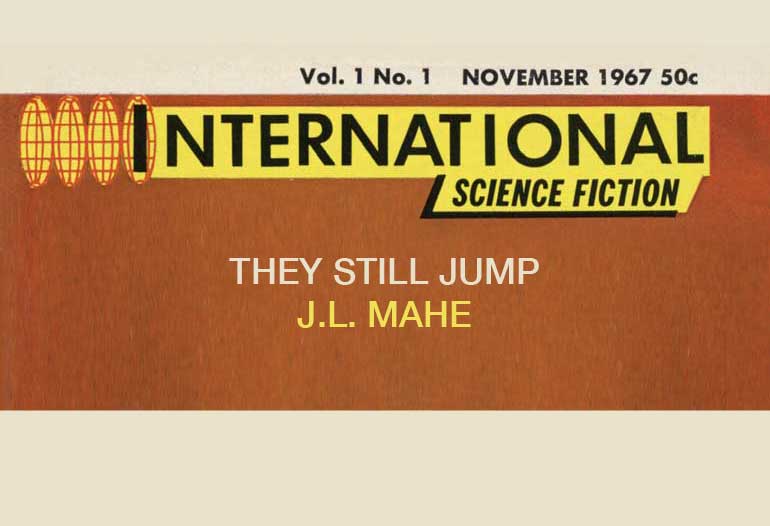
From International Science Fiction No. 1 (Nov. 1967):
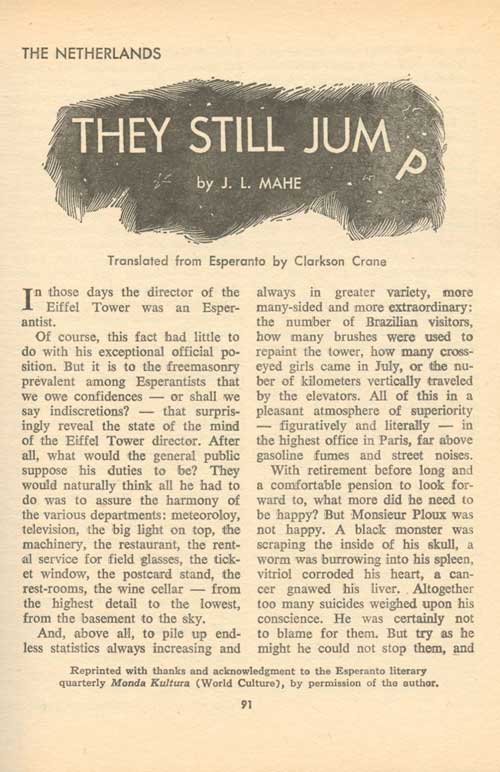
“They Still Jump” is a story by J.L. Mahe from The Netherlands. It originally appeared in Monda Kultura (World Culture) in Esperanto, from which it was translated by Clarkson Crane.
The director of the Eiffel Tower, Monsieur Ploux, has a problem. Far too many are using the iron lady as their method of choice for suicide.
From the first level jumped the lovelorn, those with toothaches, the alcoholics, the unlucky bettors, the insane; from the second, widowers, bankrupts, gamblers, tax-payers; from the third, philosophers and poets.
It is an epidemic. Numerous methods are tried to end it but none can deter the determined. That is, until Monsieur Ploux puts his head together with Mr. Plow, general manager of the Golden Gate Bridge, who happens to have exactly the same problem.
“In 2007, one of my Clarion mates, Rudi Dornemann, started a website to publish a new flash fiction story every weekday by a rotating set of authors. I think there were seven or eight of us to start; we added a few others in the following years. I wrote ninety stories for The Daily Cabal, some better than others, but it was a useful exercise in hitting deadlines because if I didn’t get a story in on time, we were in trouble. Well, practically speaking there would be somebody else’s story in the queue, but I’m happy it never came to that.
The Cabal never got enough traffic, so it died after a few years, but there were some damn good stories in it.
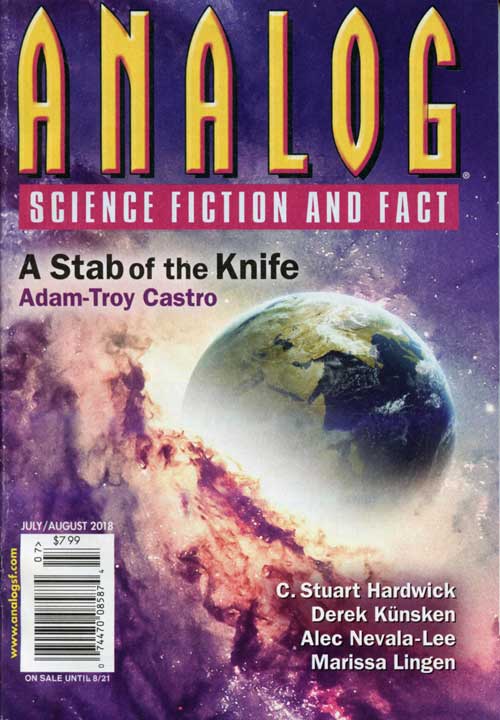
Analog Science Fiction and Fact (Astounding) Vol. 138 #7 & 8 Jul/Aug 2018
Contents Marianne J. Dyson’s Guest Editorial: Gender Parity in Space: Now and in the Future
The Analytical Laboratory (2017 readers’ vote results) Adam-Troy Castro “A Stab of the Knife” Derek Künsken: The Science Behind “The Quantum Magician” (Science Fact) Robert Frazier “The Long Night Watch” (verse) Frank Wu “Until We Are Utterly Destroyed” art by Tomislav Tikulin Evan Dicken “Generations Lost and Found” Kris Dikeman “A Simple Question” Alex Shvartsman & Alvaro Zinos-Amaro “The People v. Craig Morrison” Joe Pitkin “Potosi” art by Vincent DiFate John G. Cramer: The Alternate View: Cryptocurrency and Quantum Computing James Robert Herndon “Eulogy for an Immortal” art by Eldar Zakirov Mary E. Lowd “Welcome to the Arboretum, Little Robot” G.O. Clark “Keck” (verse) Daniel James Peterson’s Probability Zero: Preface to The Handbook of Social Treatments for Conceptual Allergies
In Times to Come (Sep/Oct preview) Andy Duncan “New Frontiers of the Mind” Alec Nevala-Lee: The Campbell Machine (special feature) M. Bennardo “Here’s Looking at You, Cud” Eduardo Vaquerizo “Render Unto Caesar” translation by Rich Larson Mary Soon Lee “Extracts from the Captain’s Notes: First Crew to Saturn’s Moons” C. Stuart Hardwick “Open Source Space” Richard A. Lovett’s The Guest Alternative View: Eclipse Unity Jacob A. Boyd “Priorities” Auston Habershaw “A Crystal Dipped in Dreams” art by Joel Iskowitz Marissa Lingen “Left to Take the Lead” Don Sakers: The Reference Library
Brass Tacks (Letters)
Classified Marketplace Anthony Lewis: Upcoming Events
Publisher: Peter Kanter
Editor: Trevor Quachri
Associate Editor: Emily Hockaday
Editorial Assistant: Deanna McLafferty
Senior Art Director: Victoria Green
Cover: NASA
208 pages, $7.99 on newsstands until August 21, 2018 Analog website
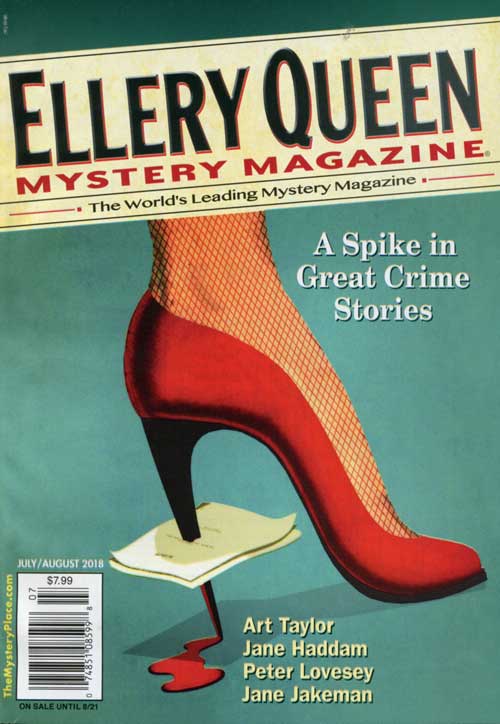
Ellery Queen Mystery Magazine Jul/Aug 2018 Vol. 152 #1 & 2, whole #922 & 923
Contents Jane Haddam “Mahadevi” art by Laurie Harden Jon L. Breen: The Jury Box John H. Dirckx “Officer Down” Art Taylor “English 398: Fiction Workshop” Sigrid Nunez “Hotel Story” Timothy O’Leary “Made Men” François Bloemhof “Proof” (Passport to Crime) Translated from the Afrikaans by Josh Pachter Peter Turnbull “The Lost Contents” Marvin Kaye writing as Archie Goodwin “Post No Bulls” Jane Jakeman “The Pale Eyes of Winter” Kristopher Zgorski: Blog Bytes William Dylan Powell “Curse of the White Armadillo” Gemma Clarke “Last Call” (Dept. of First Stories) David Dean “The Mercy of Thaddeus Burke” (Black Mask) Janice Law “The Professor” Alaric Hunt “Hidden in Shadow” (Black Mask) Peter Lovesey “Angela’s Alterations” Louisa Luna “Edgewise” Thomas K. Carpenter “The Lightness of Man” art by Ron Bucalo Amy Myers “Classic Betrayal”
Classified Marketplace Dean Jobb: Stranger than Fiction (Preview)
Publisher: Peter Kanter
Editor: Janet Hutchings
Associate Editor: Jackie Sherbow
Senior Director Art & Production: Porter C. McKinnon
Senior AD: Victoria Green
Cover: Brian Stauffer/theispot.com
192 pages
$7.99 on newsstands until August 21, 2018 Ellery Queen Mystery Magazine website

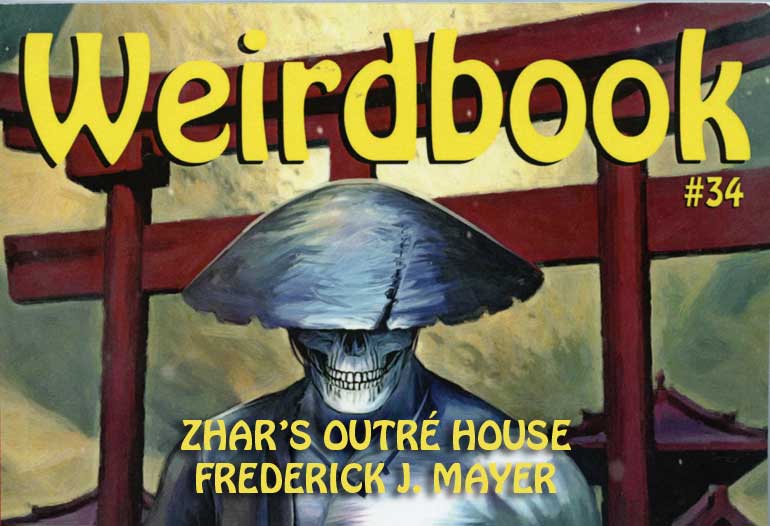
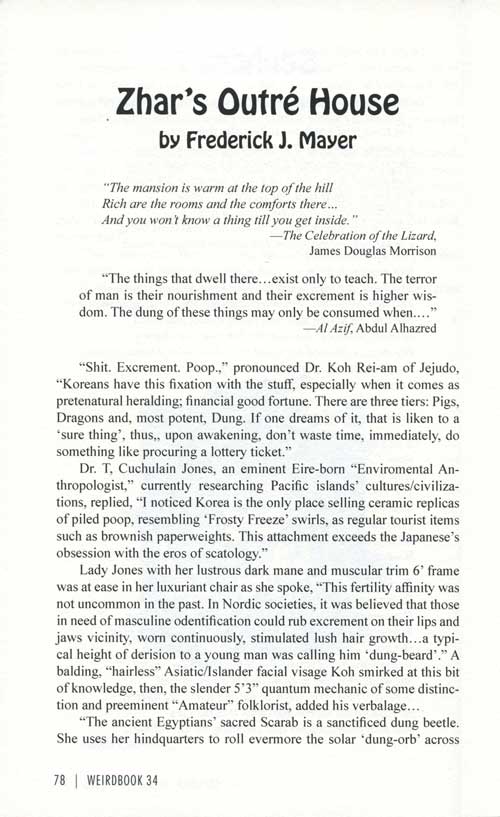 From Weirdbook No. 34: