Category

Reviews

Category

Futures Mystery Jan/Feb 2006 coverFrom the Potpourri section of The Misadventures of Ellery Queen anthology edited by Josh Pachter and Dale C. Andrews:

Grand Master Lawrence Block provides “The Death of Mallory Queen,” which first appeared in Futures Mystery Jan/Feb 2006. Publisher Mavis Mallory urges Leo Haig, a detective second only to Nero Wolfe, and his assistant Chip Harrison, to save her from what she firmly believes is her impending murder. When and where? At the upcoming twenty-fifth anniversary celebration of Mallory’s Mystery Magazine. Who and how? She provides an impressive list of frienemies; all with good reason to want her dead. And it’s no surprise when she dies, but the fun here is in both the telling and the solution to the crime. Block’s tale is witty, light, and highly entertaining.

Cover image from Galactic Central.

This review continues on May 8 . . .

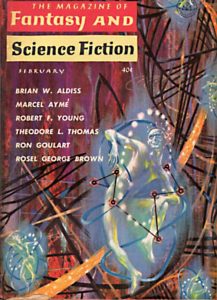
F&SF Feb. 1961 coverExcerpt from Joe Wehrle, Jr.’s review of the Hothouse series by Brian Aldiss, from The Digest Enthusiast book six:

“I have a most vivid recollection of receiving my February subscription copy of Fantasy and Science Fiction with Brian Aldiss’ Hothouse novelette. The Ed Emshwiller cover grabbed me at once with its near-abstract depiction of figures caught in a mad tangle of vegetative color. The story lived up to the illustration’s promise. And then some. And the series won a Hugo Award.”

“Hothouse begins by directly immersing us in a steaming forest habitat where humans of a greatly diminished size (one-fifth our height) struggle endlessly against semi-sentient vegetable life, and one side of Earth forever faces an aging Sun.”

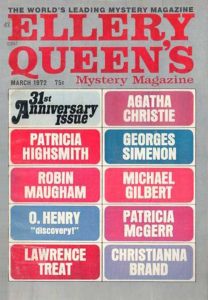
EQMM March 1972 coverFrom the Potpourri section of The Misadventures of Ellery Queen anthology edited by Josh Pachter and Dale C. Andrews:

Stephen Coleman is rich, frugal, and able to learn from his mistakes. Like setting up a joint checking account with his wife. A mistake he’s careful not to repeat with wife number two. In “The Last Check” by Patricia McGerr (originally from EQMM March 1972), Coleman leaves a signature on a blank check as his dying message. It could be a clue to his murderer’s identity if only Captain Rogan can sleuth out its meaning.

EQMM base image from Galactic Central.

This review continues on May 4 . . .

Title pageThe second feature in International Science Fiction Vol. 1 No. 1 (Nov. 1967) is a trio of reports on the state of “Science Fiction Around the World.” Walter Ernsting begins from Germany, where he reports, “After the second world war a new kind of sf became popular: modern science fiction as you know it in America and England.”

Walter Ernsting (1920–2005), who wrote under a pen name Clark Darlton, chosen by a German publisher, authored hundreds of novels, but only a few were published in the US—a few years after ISF ended.

“In 1961 some writers put their heads together, and three months later the most famous serial of the world was born: Perry Rhodan, with an edition of 200,000 copies weekly. Just now number 300 is on the newsstands.”

The writers were Ernsting and Karl-Herbert Scheer.

Perry Rhodan was quickly picked up by Ace Books in the US where 126 novels were published from 1969 through 1978. Another 19 were published independently by translator Wendayne Ackerman (wife of Forrest J. Ackerman) as Master Publications.

“Science fiction has its boom in Germany now. The Moewig-Verlag in Munich presents twenty titles every month; it is really the biggest sf publisher in the world. The agency Panorama in Vienna is the agent for most of the German authors.

Ernsting’s connection with Galaxy is also mentioned. He edited the German Galaxy paperback series that ran for 14 editions, the last five with co-editor Thomas Schlück, from 1965 to 1970.

Julius Kagarlitsky’s report from The Soviet Union is translated by Anne McCaffrey and Irina Poutiatine.

“The young writers in the late 50’s overwhelmingly desired to tell what Science is going to give the world . . . Now, however, Soviet sf is being judged solely as science-fiction literature which is devoting itself, above all else, to the questions of the social and psychological consequences of scientific and technical progress.”

He highlights the work of two writing teams—Mikhail Emtsov and E. Parnov; and brothers Arcady and Boris Strugatsky—in particular the former team’s novel Soul of the World.

“In America, many short stories are written; we write very few. Most of our science fiction writers lean toward the novel and the novelette.”

Luigi Cozzi reports from Italy. He begins with April 1952 when the first Italian science fiction magazine was launched. Scienza Fantastica lasted only seven issues, but was followed that same year by the bi-weekly Urania, which featured novels. Leveraging reprints of the best American SF novels, Urania soon reached average sales of 50,000 copies. But by the late 1960s, as sales of hardcover SF titles climbed, the magazine’s circulation dropped to about 20,000 copies an issue.

“You must consider that the Italians mean by “magazine” what the Americans usually call a ‘pocketbook.’ All Italian science-fiction “magazines” are pocketbooks featuring the cover novel, a serial (which is a short novel shared into an unbearable ten or fifteen parts) and some advertising and comics.”

Cozzi mentions several writers, but they seem to come and go, as do the dedicated science fiction magazines. He concludes by observing, “The good Italian science-fiction writers are rather few.”


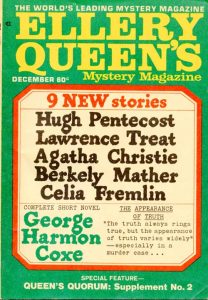
EQMM Dec. 1968 coverFrom the Potpourri section of The Misadventures of Ellery Queen anthology edited by Josh Pachter and Dale C. Andrews.

Remarkably, co-editor Josh Pachter was in high school when his first story appeared in EQMM Dec. 1968. In “E.Q. Griffen Earns His Name” a sixteen-year-old detective tackles two mysteries. The first involves a robbery, a baffling case in which his father, Inspector Ross Griffen, explains all the details. His son, E.Q., listens intently and pulls out the solution, thus “earning his name.” The second mystery is also a robbery, and its solution also lies in the details, but maybe not the ones even a clever detective might think.

This review continues on April 30 . . .

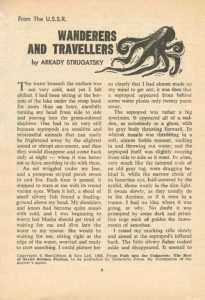
ISF No. 1 page 9The first story in International Science Fiction No. 1 (Nov. 1967) is from The U.S.S.R, “Wanderers and Travellers” by Arkady Strugatsky.

A new species of septopod has appeared and it’s Stanislav Ivanovich’s job to tag them with a miniature tracking device, part of the research effort to learn more about them. When he emerges from the cold waters of the lake some of the creatures have migrated into, the diver finds a stranger engaged in conversation with his daughter, Marsha, who waits for
her father. She introduces Leonid Andreevich Gorbovsky, an astro-archaeologist, a man we soon suspect is more than he initially appears.

“And yet there is Reason in the universe,” Gorbovsky suddenly said. “There’s no doubt about it. But it’s quite different from what we expect it to be, and we just go on looking for it in the wrong place without having a definite idea of what we are looking for.”

As the conversation progresses he suggests beings far superior to man exist. When Marsha hears a peel of thunder, he corrects her, pointing to a streak of light that flashes through the clouds.

“It’s a liner. Can’t you see it over there?”

The septopods, hidden for an indeterminate time, have suddenly risen from the depths. Why now? It’s unclear, but their discovery is analogous to the superior race the astro-archaeologist describes. Except for one thing. We know our own intensions far better than the alien visitors’.

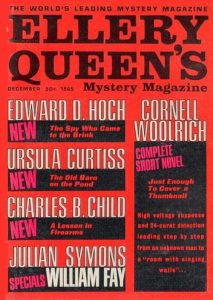
EQMM Dec. 1965 coverFrom the Potpourri section of The Misadventures of Ellery Queen anthology edited by Josh Pachter and Dale C. Andrews.

Ancient Arthur Mindy is “The Man Who Read Ellery Queen” in William Brittain’s fictional world of the Goodwell Senior Citizen Home, first printed in EQMM in Dec. 1965. Mindy’s prize possession is a complete set of books by Queen, and at the top of his bucket list is the chance to solve a mystery in the manner of the great detective. He sees his opportunity when the prize possession of another senior suddenly goes missing. It’s schmaltzy, but somehow Brittain keeps a low-key mystery vibrant and a feel-good ending, feeling good.

EQMM base image from Galactic Central.

This review continues on April 26 . . .

EQMM Nov. 1960 coverThe third section of Josh Pachter and Dale C. Andrews’ anthology, The Misadventures of Ellery Queen, is Potpourri—stories inspired by Queen. First up is “The Norwegian Apple Mystery” by James Holding, originally from EQMM Nov. 1960.

Two mystery-writer partners, vacationing on a cruise ship, are intrigued by the death of one of their fellow passengers, who choked to death on an apple while reading in bed, alone. The event sparks their collective curiosity, and once they begin speculating that it was not an accident, they soon find themselves creating a plausible plot for murder. A highly entertaining lesson in how to create a murder mystery.

EQMM base image from Galactic Central.

This review continues on April 22nd . . .

EQMM July 1967The final entry in the parody section of The Misadventures of Ellery Queen, edited by Josh Pachter and Dale C. Andrews:

Like co-editor Pachter, Dennis M. Dubin placed his first published story while still in high school—in EQMM (July 1967). However, unlike the former, Dubin’s story, “Elroy Quinn’s Last Case” was prophetic, as it seems to be the author’s last mystery as well. I can see why it concludes the parody section, yet its madcap elements balance nicely with its drama and provide a smooth transition to the collection’s final, more serious Potpourri section.

As the story opens, Elroy Quinn already long retired, is coaxed into action by Inspector Thomas Velie, who explains, “the king of Ubinorabia arrived here two days ago to begin talks on the huge oil deposit recently discovered in his country.” It’s large enough to incent dialog between East and West, but only the king supports it. His heir does not. One of the king’s bodyguards is dead, a victim of mistaken identity—meaning the monarch himself is marked for murder. Who wants him dead? The clues only deepen the mystery: “…a gladiator’s helmet and pair of cats, one with a plethora of tails.” Baffling to Velie and most mortals, but Quinn’s cogitations overcome all obstacles and justice, is at last, laid to rest.

EQMM base image from Galactic Central.

This review continues on April 18th . . .

EQMM Dec. 1964The second of three entries in the parody section of The Misadventures of Ellery Queen, edited by Josh Pachter and Dale C. Andrews:

Arthur Porges wrote two Queen parodies. His first, “The English Village Mystery” from EQMM (Dec. 1964), is reprinted here. Celery Green is called into a case too baffling for authorities East, North, and South. A dozen residents of tiny Tottering-on-the-Brink are dead; which leaves only three remaining citizens. Can Celery thicken the plot before “on” becomes “over” the brink?

EQMM cover image from Galactic Central.

This review continues on April 14th . . .