Category

Reviews

Category
Worlds of Fantasy #4 cover
Worlds of Fantasy #4 cover by Gerald Facey

Far and away World of Fantasy #4’s (1951) best story is “World of the Ancients” by C.D. Ellis. The story opens in the third era of a planet referred to once or twice as earth (not Earth). The emerging world order are the survivors of a war that nearly destroyed the planet and swept away all records of past achievement. Now a primitive society, the only remains of their world’s long bygone glory are legends of the ancient Greeks, which form the basis of their religion and beliefs. Even the names of their people are Greek names like Hercules and Diocles.

After a hunt for game, Agamemnon journeys back to his village empty-handed and spots a dense, black smoke rising above the tree line. “As his eyes sought the source of the fire and found it, he became rooted to the spot. The cold hand of fear clasp at his throat, rendering him temporarily speechless. This was no fire in the scrub surrounding the village precincts; the whole village itself was blazing fiercely.”

When at last he reaches his home, there are no survivors, including his wife. Heartbroken and traumatized, Agamemnon drags himself to the next village to find refuge and to give warning of the tragedy. The village’s chief, Aramis, invites him to join their village, and a posse forms to investigate the cause of such a great fire that could destroy an entire village so swiftly and completely.

A long and difficult search ensues until finally their fears are borne out. “Nestling in the dense scrub below him was a long, sleek, black oval of polished metal, about one hundred feet long. It lay about seventy to eighty yards down the slope. At one end was a pointed nose, while at the other were several tubular projections.”

Tension mounts as the threat of the space invaders increases until the final showdown, which for me was both unexpected and unfortunate.
Galactic Central lists “World of the Ancients” as C.D. Ellis’ only short story published in a magazine. Unfortunate—I thought it was well conceived and well written; its only weakness, the ending.

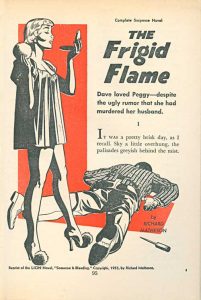
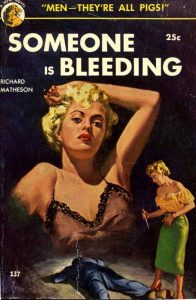
Story splashpagePublisher Martin Goodman started both Non-Pareil (Justice) and the Lion paperback book line, so it’s no surprise the novels featured in the digest magazine first appeared as Lion paperbacks a few years earlier. The seventh, and final story in Justice Amazing Detective Mysteries #3, October 1955 is Richard Matheson’s “The Frigid Flame,” which was first published as Someone is Bleeding by Lion in 1953.

Matheson is best remembered for his science fiction and horror novels, but he wrote suspense and thrillers too, and this one could be labeled as such—or noir. Young Davie Newton falls hard for the beautiful, but unpredictable Peggy Lister, a young woman with a past. The story is ripe with action and plot twists, and Matheson’s excellent writing does a good job selling the sometimes melodramatic events and dialogue. The mystery here is whether the story is true noir, or a crime drama that wraps things up with a happy ending—and you won’t know for sure until the final page.

Someone is Bleeding coverJames Reasoner’s Rough Edges and Admiral Ironbombs’ Yellowed and Creased cover reviews of the paperback version of the story.

“The Frigid Flame” gives this issue of Justice a strong finish, but overall I’d give the previous edition from July 1955, a slight edge.

Peter Enfantino provides synopses for all four issues of Justice in The Digest Enthusiast book five.

The sixth story from Justice Amazing Detective Mysteries #3, October 1955:

Story slashpage

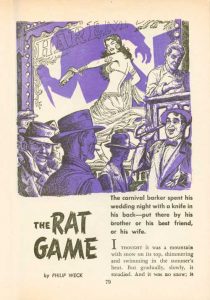
The quirky elements of Philip Weck’s “The Rat Game” keep an otherwise mediocre whodunit entertaining. The Rat Game itself is rigged in favor of the carny barker who runs it. But the rubes who play along aren’t the only ones being gouged. As the story opens, it’s the barker who’s left face down in an alley, stabbed in the back with a shiv. He miraculously survives despite his refusal to allow the wound to seal properly, while he repeatedly attempts to solve the mystery of his would-be murderer from the narrow list of suspects—his wife, brother, and best friend.

Weck had success with several dozen stories from 1947 to 1961 published in popular pulps and digests like Manhunt and Trapped. I found his “You Can’t Run Away” from Suspense Magazine (Fall 1951) to be outstanding. Michael L. Cook, in Mystery, Detective, and Espionage Magazines highlights the story in his entry on Suspense. “[Weck]…tells with some power about murder resulting when a G.I. returns home and his girl has married someone else.”

The fourth story from Justice Amazing Detective Mysteries #3, October 1955:

Story splashpage

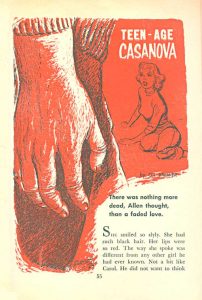
Misperceptions abound in Gil Brewer’s “Teen-Age Casanova.” Carol loves Allen, and Allen used to love her back—until he fell hard for Binnie. Now he’s as gaga over Binnie, as Carol is over him. He makes it clear to Carol that he’s done with her—again and again. Yet she persists. In fact, Carol’s indefatigable—unbelievably so. What’s a teenage casanova to do? Allen cobbles together a reverse stalker murder plan that bites back.

Gil Brewer (1922–1983) was a major paperback original writer in the 1950s. His short stories sold to all the digest magazines of the day, most notably Manhunt, The Saint, Pursuit, Hunted, and the short-lived Accused. Bill Pronzini wrote a chapter about him for The Big Book of Noir, citing his novels The Red Scarf and Nude on Thin Ice as two of his best. Hard Case Crime and Stark House Press have reprinted over a dozen of his novels, keeping the works of one of the great 50s and 60s noir writers in print for today’s readers.

The second story from Justice Amazing Detective Mysteries #3, October 1955:

Story splashpage

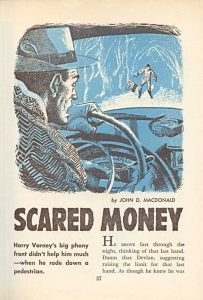
By 1955, John D. MacDonald had already written a dozen novels, so Justice editor Harry Widmer was fortunate to secure a short story from the prolific author. MacDonald’s fine writing is the only bright spot in this story of a gambler who kills a pedestrian on his drive home from another in a string of big losses. The vapid ending does nothing help this lackluster tale.

A grandmaster of mystery writers, “Scared Money” is not a good representation of MacDonald’s normally exceptional work.

The special feature in Marvel Science Stories, May 1951, on “The Dianetics Question” begins with the following introduction:

“CONTROVERY is the life-blood of intellectual development, and all too often, publications take one side or the other, from bias, advertising pressure, or just plain fear. MARVEL dedicates itself to the honest presentation of those arguments which rage throughout the science-fiction field. Each issue will see a forum by leading writers in the field, presenting their opinions on the issue. It is up to you, the readers of MARVEL SCIENCE, to let us know which topics you would like to see your favorite writers battle out. Get those letters in now!”

The pro stance is supplied by L. Ron Hubbard himself in “Homo Superior—Here We Come.” Hubbard devotes about half of his four pages in offense to Lester del Rey’s essay and half on the improvements in confidence and emotional well-being of several Dianeticists.

A noteworthy endorsement interrupts Hubbard’s presentation in bold text:

Forest Ackerman quote

Theodore Sturgeon’s neutral stance is addressed only in passing by Hubbard, “. . . all we ask
 is the kind of honest skepticism which you display, Mr. Sturgeon.”

Sturgeon’s contribution, “How to Avoid a Hole in the Head” is mostly an admonishment to keep an open mind until you understand a subject well enough to criticize or endorse it.

It’s clear from Lester del Rey’s “Superman—C.O.D.” that he’s highly skeptical of Dianetic’s claims. But his criticism is presented logically and he’s open to proof if only the organization will provide it.

After nine pages, none of the arguments changed anything for me, but I did learn a bit more about the still controversial subject . . . .

If you’re a fan of Manhunt, Justice, which lasted only four issues, is a worthy addition to your collection. The third issues starts out strong with a novelette by William R. Cox called “Las Vegas Trip.”
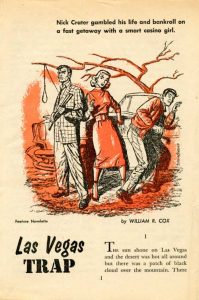
Splashpage of Las Vegas Trip

Anthony Boucher wrote in his review of Death on Location (1962) that Cox wrote about gambling “more convincingly than anyone except Ian Fleming.” In “Las Vegas Trip” gambler Nick Crater is a little too good for the crooked poker tables at the Flaming Arrow hotel’s casino. When confronted by a wiseguy named Buster, Nick foolishly adds to his troubles by decking the guy. That mistake forces him to gather his winnings and flee. Fortunately, the casino B-girl he met earlier, Meg Bond, also wants out of Vegas after the beating she took at some point prior, curtesy of Buster. Nick doesn’t know if he can trust her, but he needs a ride so he bets she’s on the level. She drives fast and they soon find themselves in the farm district of California, in a small berg, name of Suntown.

They ought to lay low, but Nick hears about a poker game run by the town’s sheriff and can’t resist. He plans to simply watch, but of course, he’s soon drawn into the game. He does manage to keep his gambling itch under control and resist changing the luck of the evening’s big winner, their motel’s owner, Bull Barber. Unfortunately, the big man’s luck runs out anyway. By morning, Nick learns Bull has been robbed and murdered, and finds himself drawn into the mystery of whodunit when the sheriff’s lead suspect is obviously the victim of a setup.

There’s romance, bigotry, gunplay, and pathos as the story unfolds, culminating in a neat ending that ties up loose ends and serves Justice well.
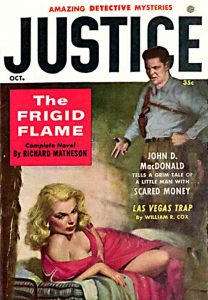
Justice #3 cover

William R. Cox wrote 80 novels over his long career as a freelance writer. He purportedly averaged over a half-million published-words-a-year for 14 years during the pulp era. In addition to his sports, mystery, and western fiction, he also wrote the biography Luke Short: Famous Gambler of The Old West.

His wife, Casey, said that her husband died at the typewriter while at work on his 81st novel, Cemetery James and the Tombstone Wars, in August 1988. Cox also wrote several novels under the name Jonas Ward.


Story splash page

The final story from Justice Amazing Detective Mysteries #2, July 1955, is billed as a “complete suspense novel.” It’s a reprint from the Lion Books edition, first published in 1952, one of only three novels Richard S. Prather wrote that does not feature Shell Scott.

“Lie Down, Killer” stars Steve Bennett, who it turns out is the perfect patsy to frame for a series of murders by crime boss Oscar Gross and femme fatale, Margo Whitney. It’s a carefully plotted mystery that unfolds rapidly with plenty of action and romance along the way. The brutal showdown between the villains and hero had me flying through the final pages to reach its satisfying conclusion.

With issues like this one, it’s particularly unfortunate Justice didn’t last longer than four issues.

Lion cover image from Pulp Serenade.

Lie Down, Killer cover of first edition

As featured in Marvel Science Stories May 1951:

Arthur C. Clarke provides the seventh story in this issue of MSS, a light-hearted adventure about an alien scouting party sent to Earth to size things up before they take over. The title, sets the tone: “Captain Wyxtpthll’s Flying Saucer.”

Marvel Science Stories May 1951 cover

In addition to Clarke’s fame as a writer, he also hosted several documentary television series in the 1980s (Mysterious World, World of Strange Powers, and Mysterious Universe), available today on DVD.

Seventh story from Justice Amazing Detective Mysteries #2, July 1955:

Story splash page

Magnus Johnson is on trail for the murder of room steward, Rolf Pentecost. The victim allegedly molested Johnson’s wife, Cornelia, in her cabin on the Alaska Star, en route from Seattle to Juneau.

Herron’s capable prose includes moments that sparkle. Early on, Johnson declairs: “I killed the dirty rat, Judge. Why waste the Government’s money with a trial? I killed him, and I’m glad. Let’s get it over with.”

The defendant shot Pentecost at Johnson’s home, where the steward warned Cornelia he’d turn up after the ship docked. But what Johnson doesn’t know is that Pentecost was already dead, and one of the jurors, Paul, was the one in Cornelia’s bed, not the steward—at her invitation!

Fortunately, during her testimony at Johnson’s trial, Cornelia has a change of heart and Justice prevails.

Other crime stories by Edward A. Herron appear in 10-Story Detective Magazine (April 1948), Black Mask (July 1949), Mystery Tales (Dec. 1958), and a few others. He also wrote several nonfiction books about Alaska.