
Category

Reviews

Category

Pulp Literature No. 15 Summer 2017Stories from Pulp Literature No. 15 Summer 2017:

“Gret” by Brenda Carre sets the issue’s opening bar high. It’s the first chapter of a forthcoming novel of the same name, so beautifully written it overshadows any hesitation of reading an excerpt, so don’t miss out. Gret’s world is harsh and dangerous, filled with magic and intrigue. Carre’s skill with dialect in narration and dialogue transports you to Gret’s world at once. “I grabbed Isk’s meat knife and a bannock or two for my tattered pockets and I was out that windee and into the shore mist faster than a clam can fart.” A three-page interview with Carre follows her novel’s chapter.

Switchblade issue twoStories from Switchblade issue two, edited by Scotch Rutherford:

“Salsa Verde” by Renee Asher Pickup gives a first person account of a robbery in-progress for the spoils of an earlier heist by the narrator and her partner. Good idea, good action, and good dialogue—that’s an anaphora, the repetition of a word or phrase that begins every clause. Unfortunately, there’s one in “Salsa” too. “It’s my job to do this,” “It’s his job to do that,” recurring often enough to call attention to itself; which for me, broke the story’s otherwise natural flow.

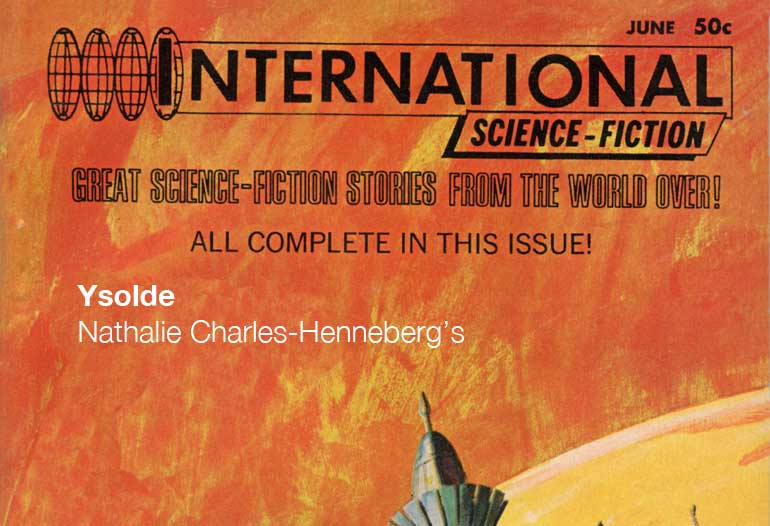
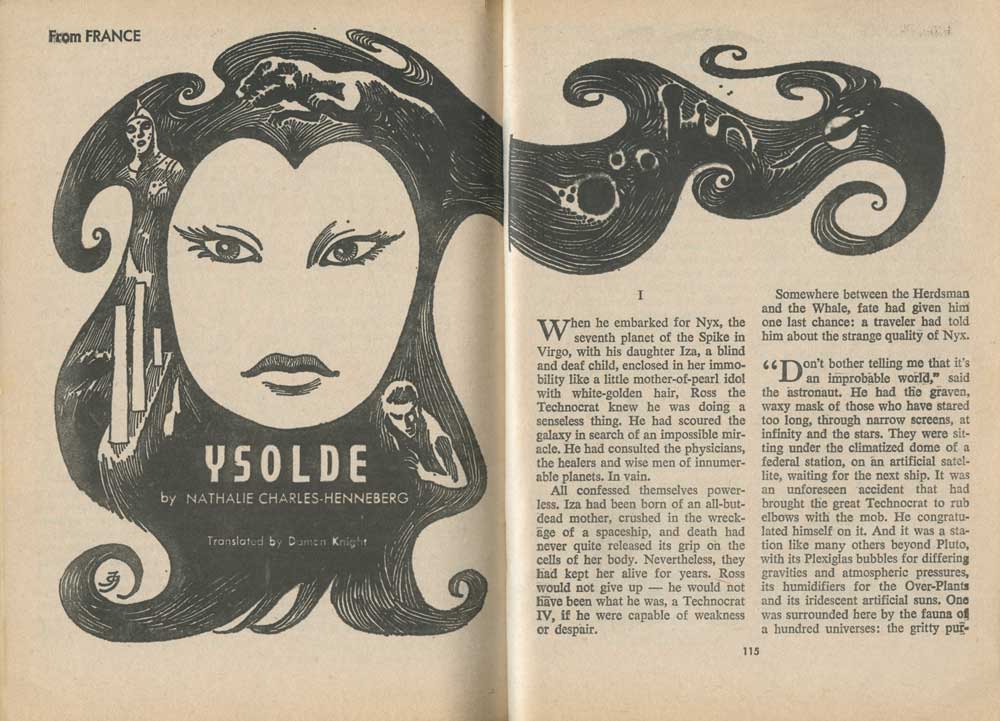
International Science Fiction No. 2 pages 114 & 115From International Science Fiction No. 2 (June 1968):

ISF closes its second issue on a high note with a story from France. “Ysolde,” by the series’ only female author, Nathalie Charles-Henneberg, is translated by Damon Knight. A bittersweet story rich with unexpected twists and bents as it unravels.

“Ah, Nyx! That’s something else again. Everything is real there, but time flows backward. Is it an effect of the planet’s rotation, or of its sun, Spica?”

Perhaps this mysterious world, long ago effaced from the astrogational maps, holds the key to freeing Iza, a blind, deaf child with white-golden hair, imprisoned in her own body.

Nathalie Henneberg (1910–1977) began her writing career collaborating with her husband Charles Henneberg on his novels. After his death in 1959, Nathalie continued writing, initially as Nathalie Charles-Henneberg, and later as simply Nathalie Henneberg. Her solo stories were more fantasy than science fiction.

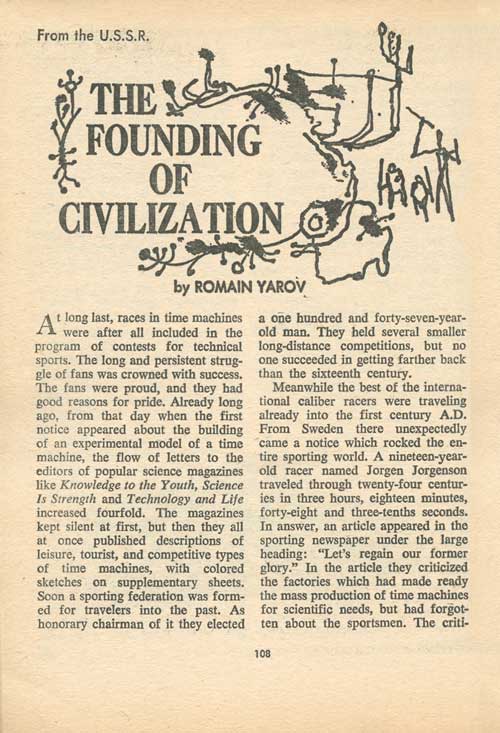
International Science Fiction No. 2 page 108From International Science Fiction No. 2 (June 1968):

ISF2’s final tale from the U.S.S.R., “The Founding of Civilization” by Romain Yarov begins with the concept of time travel as a sporting event.

A nineteen-year-old racer named Jorgen Jorgenson traveled through twenty- four centuries in three hours, eighteen minutes, forty-eight and three-tenth seconds.

This record-breaking performance sparks the public’s interest and the real race begins. The sport is accepted into the Spartacus Games and the world’s champions compete, including the favorites Vassily Fedoseyeyv and Konstantin Paramonov.

The race begins. Tension is high. Fedoseyeyv is expected to win, but not only does Paramonov triumph instead, but every other participant returns before the famed Soviet. Finally, as hope to avert a disaster is nearly gone, Fedoseyeyv returns. He had stopped. A technical glitch had forced his hand. An error that disqualifies him from the race and the sport for several months. Where did he stop? The 33rd century BC. The primitive people there helped him and in return he left them a gift that turned out to have some rather long-term significance.

Two collections of Soviet SF stories that include some overlap of the stories/authors from ISF were published in English editions. Yarov’s “The Founding of Civilization” was reprinted in Other Worlds, Other Seas (Random House 1970) and his story “Goodby, Martian!” was included in The Molecular Cafe (Mir 1968).

Weirdbook No. 34 page 179From Weirdbook No. 34:

In “Trick” by Rish Outfield, a self-absorbed dad gets a handful on Halloween when he takes his daughter trick or treating.

I imagine poetry is even more challenging to write and sell than fiction. Weirdbook provides six poems in this issue, the short ones used to fill out the last page of a story, and the longer ones to provide a break between the fiction. This issue includes verses by Steve Dilks (2), Darrell Schweitzer, Ashley Dioses (2), and Lucy A. Snyder.

Editor Doug Draa has done excellent work curating a diverse mix of weird fiction and poetry
for Weirdbook No. 34. Highly recommended for fans of fantasy, horror, supernatural, and science fiction. Every story was entertaining and worth reading. My favorites were those by Adrian Cole and Sean Patrick Hazlett. And I’d rate James D. Mabe’s “Touched” as the best of the book by a shake—a tremble actually.

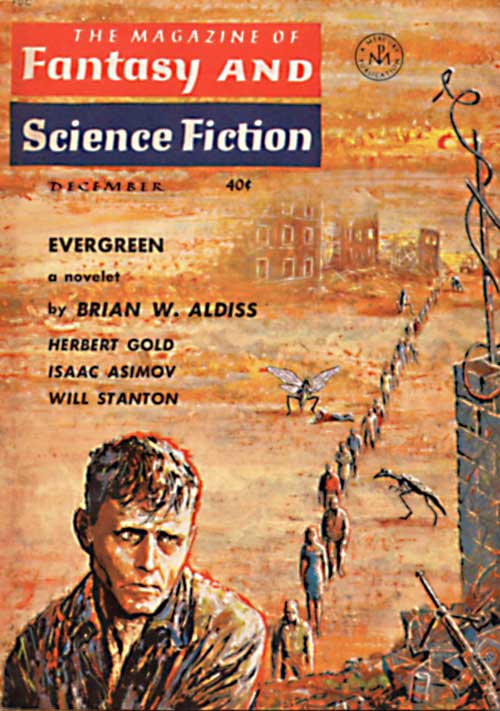
F&SF Dec. 1961The fifth and final episode of Brian Aldiss’ Hothouse saga appeared in Fantasy and Science Fiction (Dec. 1961).

Contents
Claude Veillot “The First Days of May” Translated from the French by Damon Knight (“Les Premiers Jours de Mai”, Fiction May ’60).
Herbert Gold “The Mirror and Mr. Sneeves” Story #3, ed. Whit & Hallie Burnett, A.A. Wyn 1953
Anne Walker “The Oversight of Dirty-Jets Ryan”
Will Stanton “You Are with It!”
John Anthony West “The Fiesta at Managuay” Call Out the Malicia, Heinemann 1961
Grendel Briarton “Through Time and Space with Ferdinand Feghoot: XLVI”
Isaac Asimov’s Science: The Trojan Hearse
Hal Draper “Ms Fnd in a Lbry or The Day Civilization Collapsed”
Brian W. Aldiss “Evergreen” (Hothouse No. 5)
Index to Volume 21

Cover by Ed Emshwiller

Contents from Galactic Central

An excerpt from Joe Wehrle, Jr.’s review of the Hothouse series, from The Digest Enthusiast book six:

[In “Evergreen”] Yattmur and Gren have a child. Gren has become more and more distant and inhuman under the influence of the morel. The morel is soon to sporulate, and it wants to transfer itself to the young, strong child, which can carry it back to the sunlit world for seeding.

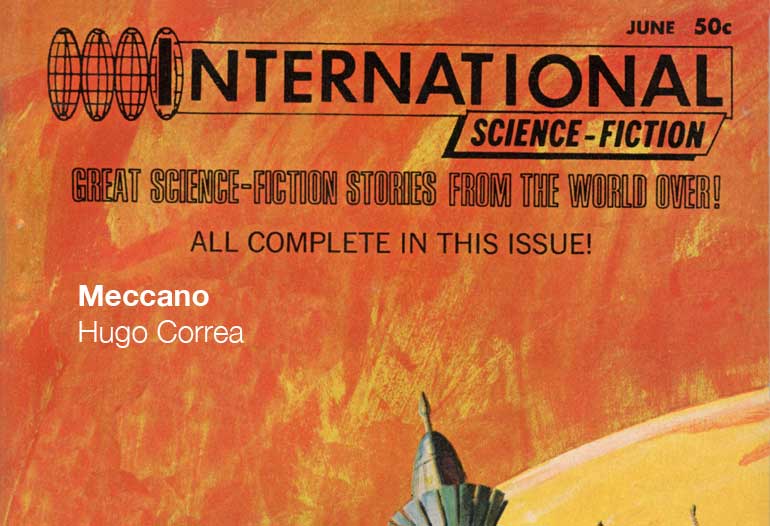
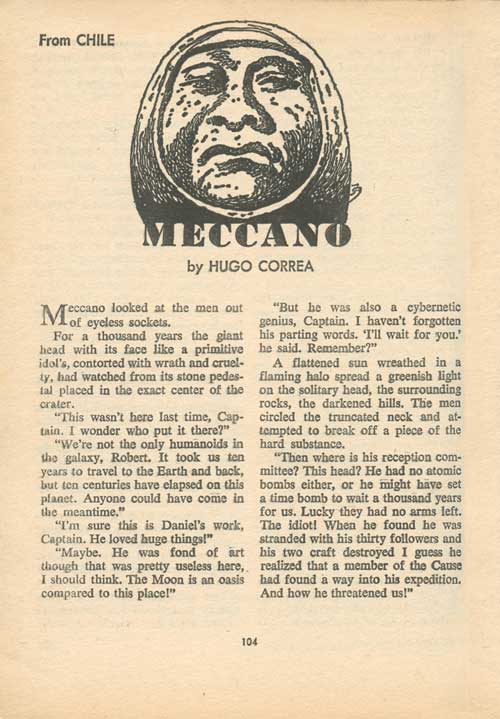
International Science Fiction No. 2 (June 1968) page 104From International Science Fiction No. 2 (June 1968):

From Chile, “Meccano” by Hugo Correa is about a robot, a gargantuan guardian, tall as an eighty-story skyscraper, that protects the precious ore on a mysterious planet from those who would mine it; like the Earth crew filling the holds of their spacecraft as the story opens.

Hugo Correa (1926–2008) was a journalist and a pivotal figure in Latin American science fiction. A few of his stories have been translated into English: “The Last Element” Fantasy and Science Fiction (April 1962); “Alter Ego” F&SF (July 1967); and “When Pilate Said No” Comos Latinos: An Anthology of Science Fiction from Latin America and Spain (Wesleyan University Press 2003).

Editors Andrea L. Bell and Yolanda Molina-Gavilán wrote in their introduction to Comos Latinos:

Thus Latin America SF entered its first golden age, a period generally thought to have run for about fifteen years starting in 1959, the year when Chile’s Hugo Correa published his modern classics The Superior Ones (Los altísimos) and Someone Dwells within the Wind (Alguien mora en el viento).

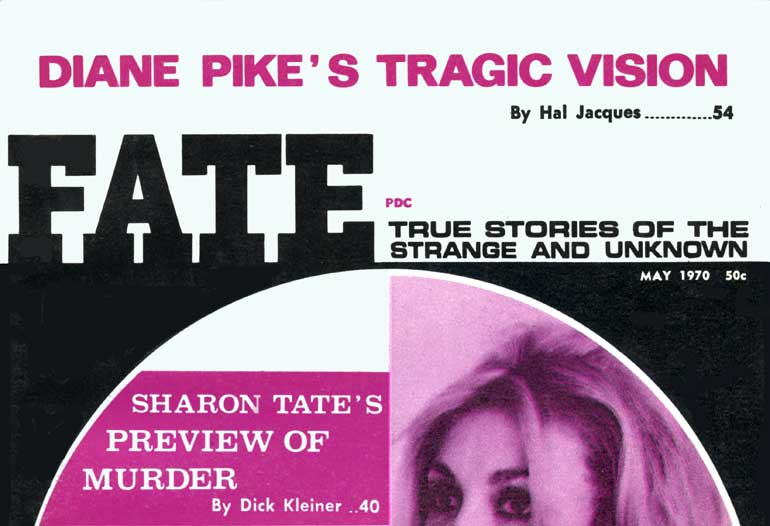
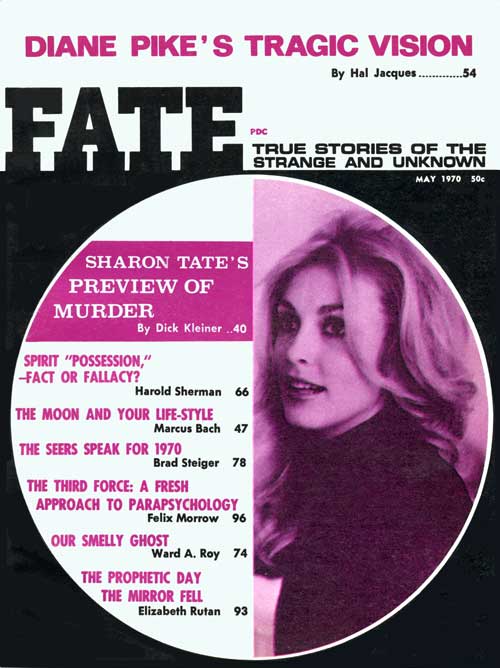
Fate Vol. 23 No. 5 (No. 242) May 1970Excerpt from Tom Brinkmann’s article, “Sharon Tate’s Fate,” from The Digest Enthusiast book six:

Fate’s May 1970 issue ran one of the earlier post-murder “weirdness” articles titled, “Sharon Tate’s Tragic Preview of Murder!” by Dick Kleiner. The article related the tale of Tate’s run-in with the ghost of Hollywood producer Paul Bern.

Tom Brinkmann writes about unusual, off-the-beaten-path magazines, digests, and tabloids. His Bad Mags website was active from June 2004–July 2017. His books, Bad Mags Volume 1 (2008) and Volume 2 (2009) are available from secondary outlets, including amazon.com

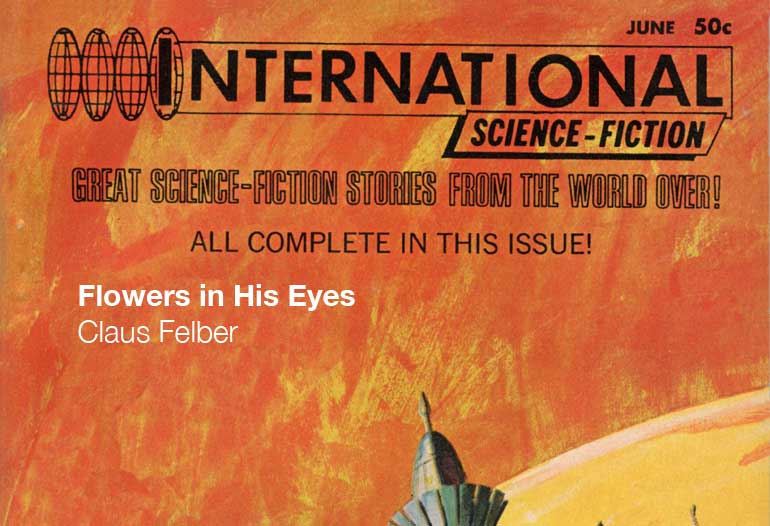
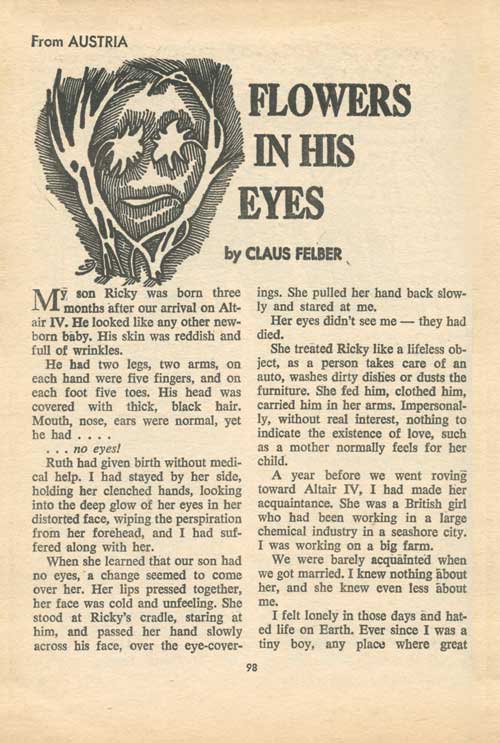
International Science Fiction No. 2 page 98From International Science Fiction No. 2 (June 1968):

From Austria, “Flowers in His Eyes” by Claus Felber is a haunting story about a family that becomes obsessed with a species of multi-colored lilies on Altair IV. This appears to be Felber’s only translated story.

Weirdbook No. 34 page 170From Weirdbook No. 34:

A short excerpt from Greg Jenkins’ “Thrill My Soul” provides both the tone and gist of his story: “Right away, I had a bad feeling about what I was in for. Anytime Death offers you his hand and says Come with me, chances are you’re not going to Disney World.”