Category

Reviews

Category

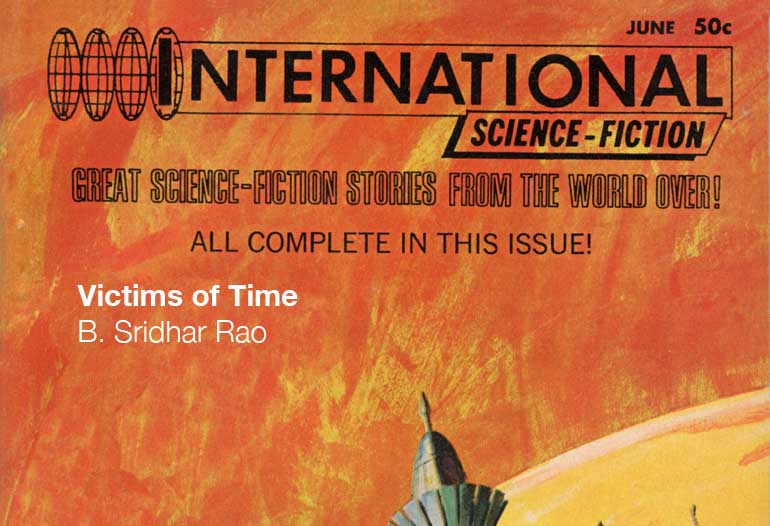
International Science Fiction No. 2From International Science Fiction No. 2 (June 1968):

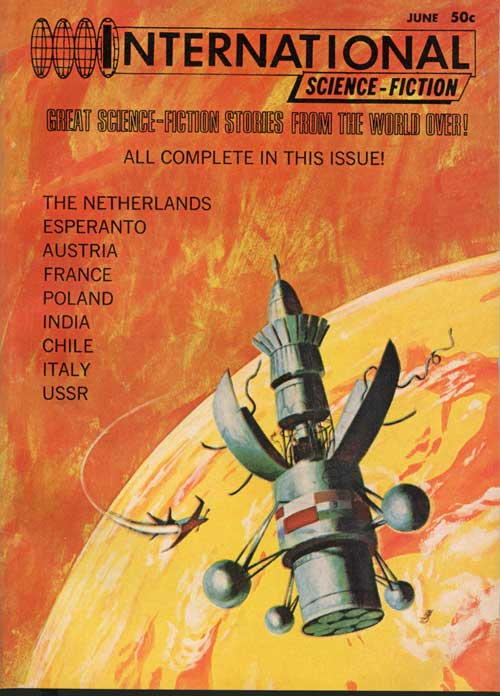
From Poland, “Heroic Symphony” by G. Altow, translated by George T. Zobrowski, was also the subject of ISF #2’s cover painting by Jack Gaughan. A probe, sent into deep space to the star Van Maanena forty years ago, is returning to Earth. The old man who designed is joined by a young man at a nearly deserted spaceport in the mountains. Neither character is named. The youth is young enough to be the older man’s grandson.

The younger defers to the old man’s deliberate, quiet approach, controlling his initial impulses at times, on faith alone. This interplay between the exuberance of youth and the experience of age are as much a part of the story as the action.

When the probe arrives, it plunges into a nearby lake, then bobs to the surface. A small “vehicle” detaches itself from the ship and heads for the shore, for the hanger. The youth comments on its clever design like an amphibious sled.

The old man explains the development problems with the robots.

“They had to be able to travel over the roughest terrain imaginable. Some moron built a robot that was man-like. What nonsense! Why should we duplicate all of man’s bodily defects? The results were disastrous. Finally we built this sled-amphibian and yet it still doesn’t solve all the problems.”

The old man methodically examines the robot’s exterior and concludes it has been completely torn down and reassembled by some beings of extraordinary intelligence.

The star Van Maaena has one planet, and the beings who live there live in a world of anti-matter. The same atoms, but instead of electrons, positrons, protons, neutrons, mesons—anti-protons, anti-neutrons, and anti-mesons.
The aliens had learned how to safely cross the void between matter and anti-matter. When the two men hear the robot’s audio recording they learn the aliens are on their way to Earth.

Genrikh Saulovich Altshuller (1926–1998) was imprisoned as a preteen for political reasons, under the Stalin regime. The experience left impressions that remained throughout his life. In “Heroic Symphony” he wrote:

Only very strong men can be confronted directly with their youth, shrug and go on their way. Cowards avoid such encounters; men of integrity grow stronger through them.

After his release he went on to become an engineer and created the Theory of Inventive Problem Solving, known by its Russian acronym TRIZ. He served as the first President of the TRIZ Association. He began writing science fiction in the 1950s under the pseudonym Genrikh Altov (Altow), often with his wife, Valentina Zhuravleva. Only a handful of his stories have been translated into English. He died on September 24, 1998 from complications of Parkinson’s disease.

International Science Fiction No. 2 page 63From International Science Fiction No. 2 (June 1968):

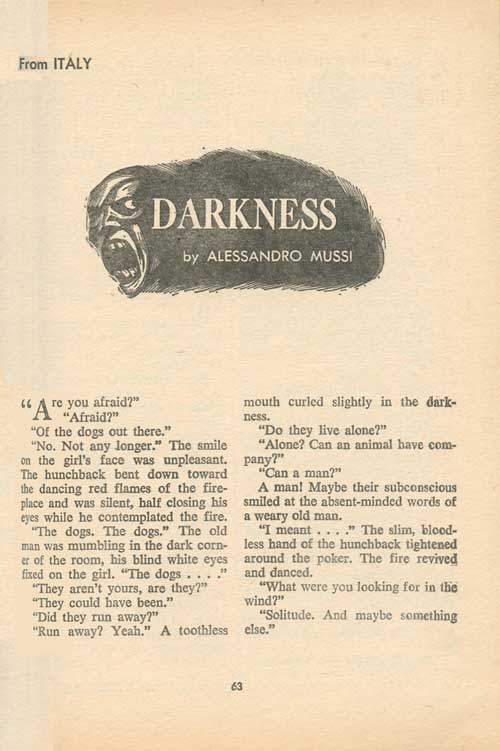
From Italy, Alessandro Mussi brings us “Darkness.” A young girl falls in with a hunchback and a blind man, who often speak in questions over the story’s three pages. She’d best stay with her new friends, there are too many questions about her old ones. A bit too vague to satisfy this reader.

Alessandro Mussi (1945– 2008) wrote half a dozen stories and one novel in the 1960s.

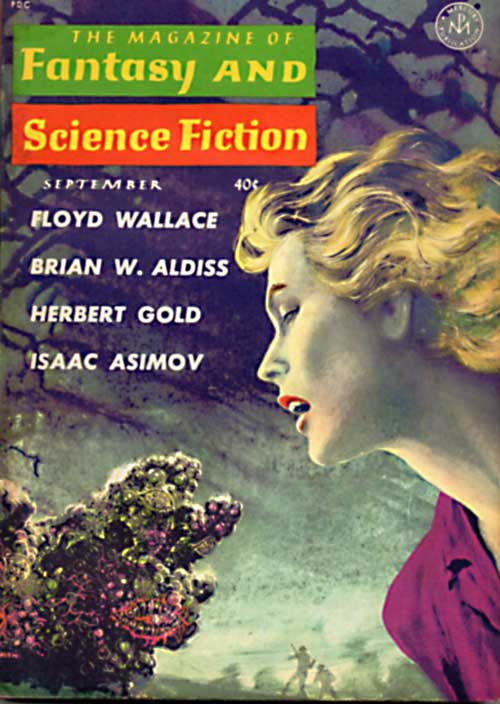
F&SF Sep. 1961The fourth part of Brian Aldiss’ Hothouse saga appeared in Fantasy and Science Fiction (Sep. 1961).

Contents
Gerard Klein “The Monster in the Park” translated by Virginia Kidd
Herbert Gold “The Day They Got Boston” (Metronome Jan. 1961)
Grendel Briarton “Through Time and Space with Ferdinand Feghoot: XLIII”
Michael Young “The Timekeeper”
F. L. Wallace “Privates All”
Nils T. Peterson “Pecking Order”
Rosemary Harris “Hamlin”
Isaac Asimov: Science: Not As We Know It
Rosser Reeves “Effigy” (verse)
Rosser Reeves “E=mc²” (verse)
Brian W. Aldiss “Timberline” (Hothouse No. 4)

Cover by Ed Emshwiller

Contents from Galactic Central

An excerpt from Joe Wehrle, Jr.’s review of the Hothouse series, from The Digest Enthusiast book six:

“The story “Timberline” (September 1961) finds the travelers far from their natural home, a place where the Sun seems to hang low over the water, and the air is cold and misty. A land of eternal sunset. The boat grounds on an ice shelf, and Gren and Yattmur urge the fishers out of it and onto an islet, where they all live fairly contentedly for a time.”

International Science Fiction No. 2 page 49From International Science Fiction No. 2 (June 1968):

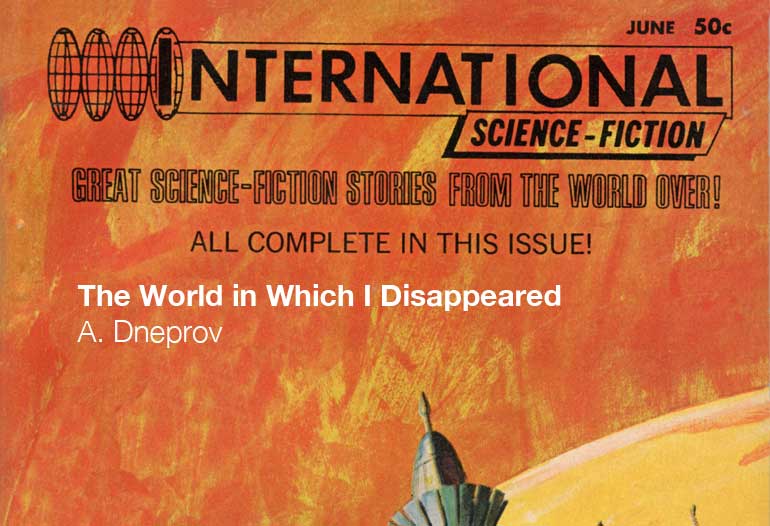
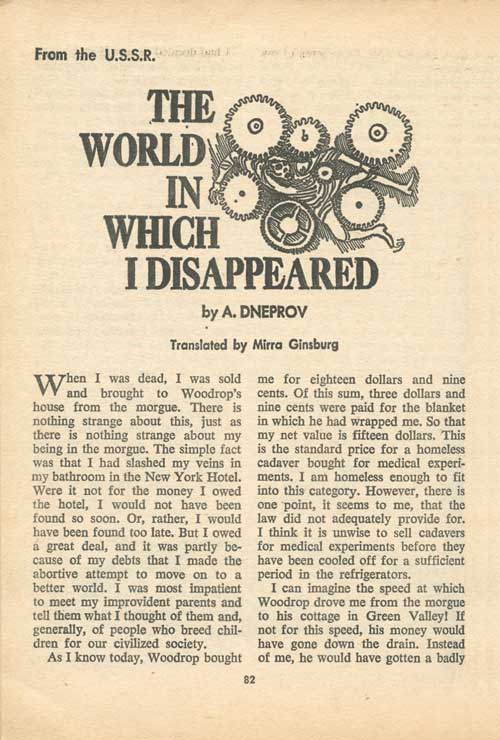
The U.S.S.R. grabs the spotlight with “The Island of the Crabs” by A. Dneprov, an issue highlight. Isolated on a tropical island, an engineer conducts a Darwinian experiment with self-replicating, evolving robotic crabs.

Cookling squatted down and began to chortle.
“Will you stop grimacing like an idiot!” I shouted. “Where did the second crab come from?”
“It was born! It was born during the night!”

Theoretically, the crab’s military potential could be unlimited, but the engineer soon learns that playing Mother Nature is not for the ill equipped.

Anatoly Dneprov (1919–1975) was a distinguished physicist who worked at an institute of the U.S.S.R. Academy of Sciences. His best known story is “The Maxwell Equations,” published in English in 1963. His short story “Formula for Immortality” was included in the New Soviet Science Fiction anthology (1979), edited by Theodore Sturgeon.

ISF No. 2 page 44From International Science Fiction No. 2 (June 1968):

From France, “Notes From a Cyclical Housewife’s Diary” by Juliette Raabe, is translated by Damon Knight. Told entirely in diary entries, only backwards, in an opposite universe.

We’re going to sit down at the table. I lay out the dirty plates and silverware that were piled in the sink. Roger brings in the full garbage can.

A clever, sometimes confusing story, that remains curious and entertaining because the author, rightly, kept it short—to five pages. She obviously had fun writing it. One entry reads: “I like fish better than a cat; I don’t know why, cats give me willies.” Oppositely, Juliette Raabe (b. 1929) created a massive anthology celebrating the little beasties: The Illustrated Library of the Cat, in 1977. Prior to that she wrote two books, Brain Teasers (1967) and The Game of the Awélé (1972).

International Science Fiction No. 2 page 42From International Science Fiction No. 2 (June 1968):

Perhaps a last minute filler, absent from the contents page, “Der Heisse Kosmonaut” by Gust Gils, of The Netherlands, is a two-page romp about an astronaut conditioned 
to tolerate the heat of the Sun.

Eventually he was able to take a liquid steel shower.

The Kosmonaut completes his mission to land on the Sun, but the heat goes to his head and he refuses to conduct any research, let alone return to Earth.

Gust Gils (1924–2002) was a poet, artist and writer. He was one of the founders of the avant-garde magazine Gard Sivik in 1955. “Der Heisse Kosmonaut” is the only story I found by him in the FictionMags Index.

International Science Fiction No. 2 page 35From International Science Fiction No. 2 (June 1968):

“The Coming of Age of Soviet Science Fiction,” an essay by John R. Isaac, credits Ivan Yefremov’s Andromeda with his article’s premise.

In this single book, Yefremov has developed a Weltanschauung into a detailed future society and has thrown out enough ideas for a hundred stories, a service that should prove as beneficial for the Soviets as Well’s work has for the English-speaking world.

The article details key aspects of Andromeda’s utopian future society where happiness is derived from one’s work, followed by an overview of the novel’s plot. If it sounds like the Andromeda’s world is communist propaganda, it is. “For the dreamers of the world, whether Russian or American, Occidental or Oriential, the vision of Andromeda is a tempting one.”

Weirdbook No. 34, page 125From Weirdbook No. 34:

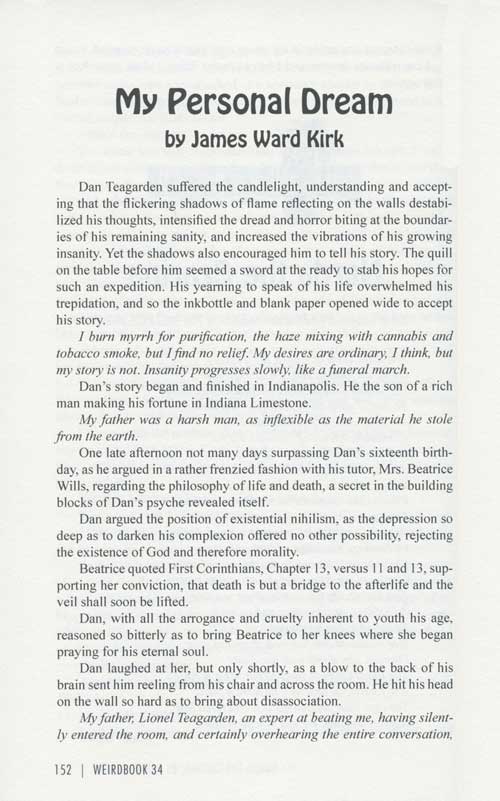
“Blood of God” by D.J. Tyrer takes place on an Anglo-Russian survey platform off Russia’s arctic coast. When the survey team discovers an extra-heavy oil deposit things turn dire. Tyrer’s frigid, isolated setting conjures memories of The Thing. As the crew opens a sample deposit it transforms their mission from research to survival in this tension-packed monster meddler.